咥
Character Story & Explanation
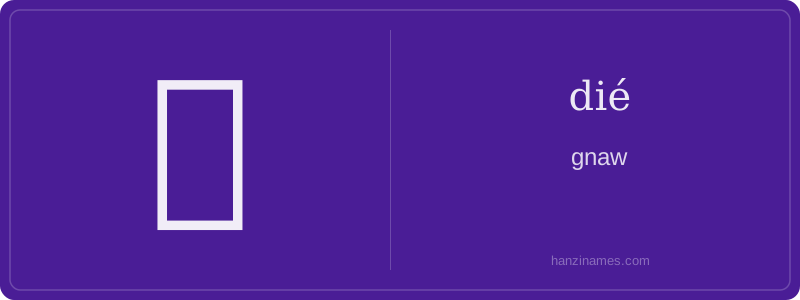
咥 is rare in modern Mandarin daily speech but persists in regional dialects—especially Northwestern China (Shaanxi, Gansu)—where it’s used colloquially for 'eat heartily' or 'devour'. It appears in the famous idiom '咥咥大笑' (xì xì dà xiào), meaning 'to laugh uproariously' (with 'xì' pronunciation), documented in classical texts like the *Book of Changes* (Yìjīng) as an onomatopoeic expression of loud, unrestrained mirth. It also survives in historical literature describing feasting or animal behavior.
The character is not pictographic but phono-semantic: 口 (kǒu, 'mouth') is the semantic radical, indicating oral action; the right component '至' (zhì, 'to arrive') serves as the phonetic hint—though pronunciation diverged over time (dié/xì). No oracle bone or bronze script forms are attested; its earliest confirmed usage is in Warring States bamboo slips and Han dynasty texts, consistently tied to vigorous oral activity.
咥 (dié) is a vivid, somewhat literary Chinese character meaning 'to gnaw' or 'to chew vigorously', often implying persistent, forceful biting—like an animal tearing at meat or a person devouring food with gusto. Unlike the neutral 'eat' (吃 chī), 咥 carries visceral, physical intensity and occasionally conveys emotional voracity, such as 'gnawing anxiety'. Its mouth radical (口) signals oral action, anchoring it in bodily experience rather than abstraction.
In English, 'gnaw' is the closest equivalent—but Western equivalents rarely carry the same cultural resonance. While 'gnaw' evokes anxiety ('gnawing doubt') or slow destruction ('rats gnawing wires'), 咥 more commonly appears in positive, earthy contexts: hearty eating, rustic vitality, or even poetic metaphors for passionate engagement (e.g., 'gnawing through a difficult text'). It’s less about anxiety and more about embodied tenacity.
Culturally, 咥 reflects a traditional Chinese appreciation for vigorous, unrefined authenticity—think of Shaanxi opera shouting, Northwest folk songs, or the robust appetite celebrated in regional cuisines like roujiamo. In contrast, Western 'gnaw' leans psychological or destructive; 咥 leans physiological and spirited. This divergence highlights how language encodes values: where English lexicalizes inner turmoil via 'gnaw', Chinese deploys 咥 to celebrate visceral presence and unapologetic engagement with life’s substance.
Example Sentences
Common Compounds
Similar Characters — Don't Mix These Up
Your First Step into Chinese Culture: Get a Chinese Name
Every journey into Chinese begins with a name. Use our free Chinese name generator to create a meaningful, personalized Chinese name that fits you perfectly.
Get My Chinese Name →