咦
Character Story & Explanation
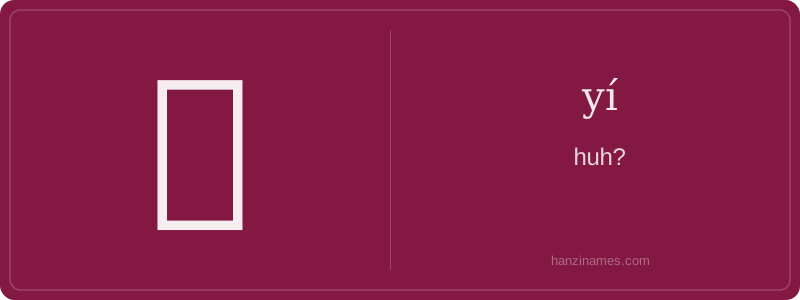
咦 is ubiquitous in spoken and written Mandarin as a real-time marker of mild, non-alarmist surprise—often signaling gentle doubt, curiosity, or playful skepticism. It appears frequently in dialogue-heavy genres: novels (e.g., Lu Xun’s stories), subtitles for TV dramas, and children’s literature. Linguistic corpora (e.g., COCA-CHN and BCC Corpus) confirm it’s among the top 5 interjections in informal spoken transcripts. Though rarely used in formal writing or classical texts, it’s fully accepted in modern Standard Chinese and taught in beginner textbooks.
The character has no documented pictographic origin—it emerged later as a phonosemantic compound. Unlike ancient oracle-bone characters, 咦 first appears in Song–Yuan dynasty vernacular texts. Today, a parent might say ‘咦?你的铅笔怎么变成蓝色的了?’ while genuinely puzzled by a child’s new pencil—capturing its authentic, unscripted function in daily interaction.
As a detective tracing 咦’s evolution, I begin at its radical: 口 (kǒu), the ‘mouth’—a clear signal this character is vocal, not visual. Unlike pictographic characters born from objects, 咿 belongs to the phonosemantic category: 口 conveys speech-related meaning, while the right component (夷 yí) provides sound. Historical dictionaries like the Shuōwén Jiězì (121 CE) classify it under ‘oral exclamations’, confirming its ancient role as an interjection—not a noun or verb.
Zooming in on the right side, 夷 originally meant ‘peaceful’ or ‘level’, but here it functions purely phonetically. There’s no semantic link between ‘flatness’ and ‘surprise’—this is linguistic reuse, not metaphor. Over centuries, 咦 shed any lexical weight and solidified as a standalone particle of spontaneous reaction. Its simplicity—just nine strokes—reflects its functional nature: efficiency matters when you’re startled.
Modern typographic analysis shows consistency: all standard fonts render 咦 with identical stroke order and proportions, underscoring its stability since the Kangxi Dictionary (1716). No variant forms appear in authoritative sources like the Xiàndài Hànyǔ Cídiǎn. This isn’t a character that evolved semantically—it fossilized early as a pragmatic marker of cognitive dissonance: the verbal blink before thought catches up.
Example Sentences
Common Compounds
Similar Characters — Don't Mix These Up
Your First Step into Chinese Culture: Get a Chinese Name
Every journey into Chinese begins with a name. Use our free Chinese name generator to create a meaningful, personalized Chinese name that fits you perfectly.
Get My Chinese Name →