咧
Character Story & Explanation
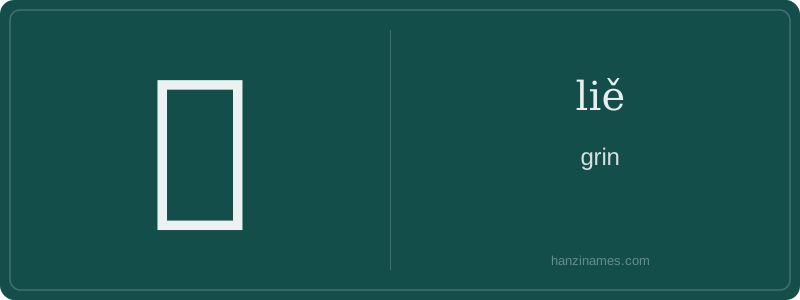
咧 is widely used in modern Chinese vernacular writing, especially in dialogue tags and descriptive narration. It appears frequently in contemporary fiction, web novels, and subtitles to convey nonverbal facial cues — e.g., '他咧嘴一笑' (He grinned broadly). While no classical idiom centers solely on 咧, it’s a staple in the fixed phrase 咧嘴 (liě zuǐ, 'to pull one’s mouth sideways'), documented in standard dictionaries like the Xiandai Hanyu Cidian (7th ed., 2016). It’s also common in regional dialect-influenced literature, such as works by Lao She.
The character is a phono-semantic compound: 口 (mouth) signals meaning; 列 (liè) provides sound. Its earliest attestation is in late imperial vernacular texts (e.g., Qing dynasty story collections), where it consistently describes mouth distortion — never as a standalone verb in classical poetry or official records. No oracle bone or bronze script form exists; it’s a later, functional creation for colloquial precision.
Hi students! Today we’re learning 咧 (liě), a fun and expressive character that captures a very human facial movement — pulling your mouth corners back, like a wide, often exaggerated grin or smirk. It’s not a neutral smile; it’s lively, sometimes teasing, sometimes awkward, and always physical. Notice the 口 (kǒu) radical on the left — this tells us it’s related to the mouth and speech or expression. The right side, 列 (liè), is mainly phonetic, helping you remember the sound.
This character appears mostly in descriptive writing and spoken-style narration — think of novels, comic books, or dialogue-heavy TV scripts. You’ll rarely see it in formal documents or academic texts. It’s a ‘vivid verb’ used to paint a quick picture of someone’s face: not just *smiling*, but *grinning sideways*, *smirking*, or even *gritting teeth in forced laughter*. Its tone is informal and visual — perfect for storytelling!
Don’t confuse 咧 with other mouth-related characters like 笑 (xiào, to laugh) or 哈 (hā, to laugh out loud). 咧 is about shape, not sound. It’s the *geometry* of the mouth — stretched horizontally, not the act of laughing. Practice writing it slowly: start with 口 (3 strokes), then add 列 (6 strokes), keeping proportions balanced. Remember: the top of 列 is two short horizontal lines — not one long stroke!
Example Sentences
Common Compounds
Similar Characters — Don't Mix These Up
Your First Step into Chinese Culture: Get a Chinese Name
Every journey into Chinese begins with a name. Use our free Chinese name generator to create a meaningful, personalized Chinese name that fits you perfectly.
Get My Chinese Name →