咯
Character Story & Explanation
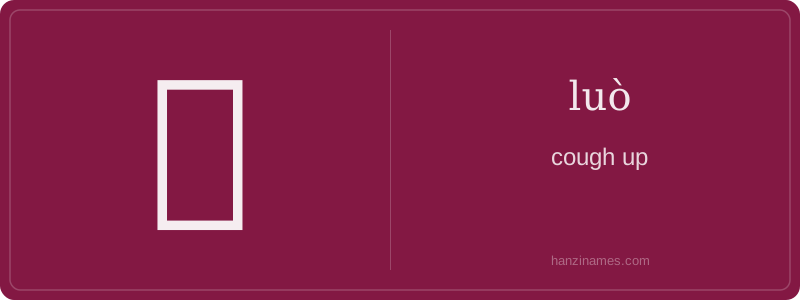
咯 is predominantly used in formal medical contexts and literary writing—not in daily conversation. Its most documented usage is in the compound 咯血 (luò xuè), meaning 'hemoptysis' (coughing up blood), appearing in classical medical texts like the Compendium of Materia Medica (Bencao Gangmu, 1596) and modern TCM diagnostics. It rarely appears alone; native speakers almost never say '我咯了'—instead, they use 咳 (ké) for general coughing. 咯 is reserved for clinically specified, often serious, expectoration events.
The character is a phono-semantic compound: 口 (mouth radical, semantic) + 各 (gè, phonetic component, sharing sound family with luò). Though 各 originally meant 'each' in oracle bone script, its phonetic role here is well-documented in Shuowen Jiezi (100 CE). No pictographic origin exists—it evolved graphically during the Han dynasty as a specialized medical logograph.
咯 (luò) is a medically precise yet culturally restrained character—its mouth radical (口) signals bodily expression, while the right component ‘各’ (gè), originally meaning 'each' or 'individually', suggests a distinct, involuntary expulsion. In traditional Chinese medicine (TCM), coughing up phlegm or blood isn’t just symptom—it’s the body revealing internal imbalance (e.g., lung heat or qi stagnation). Thus, 咯 embodies a worldview where physical acts are diagnostic windows into holistic health.
This character reflects Confucian and Daoist sensibilities: bodily functions are neither shameful nor purely mechanical, but part of an ethical-physiological continuum. To ‘cough up’ (咯血, luò xuè) is to bear witness—to one’s own condition and, by extension, to social responsibility in care-seeking. The quiet urgency of 咯 mirrors classical restraint: no outcry, only the subtle, telling sound of release.
In modern usage, 咯 retains clinical gravity but also appears in literary realism—e.g., Lu Xun’s characters coughing blood amid societal decay—symbolizing suppressed truth forcing its way out. Unlike English ‘cough up’, which colloquially means ‘reluctantly surrender’ (money, info), 咯 stays anchored in somatic authenticity. Its cultural weight lies in how Chinese discourse treats the body not as private machinery, but as a resonant chamber of moral and environmental harmony—or disharmony.
Example Sentences
Common Compounds
Similar Characters — Don't Mix These Up
Your First Step into Chinese Culture: Get a Chinese Name
Every journey into Chinese begins with a name. Use our free Chinese name generator to create a meaningful, personalized Chinese name that fits you perfectly.
Get My Chinese Name →