咴
Character Story & Explanation
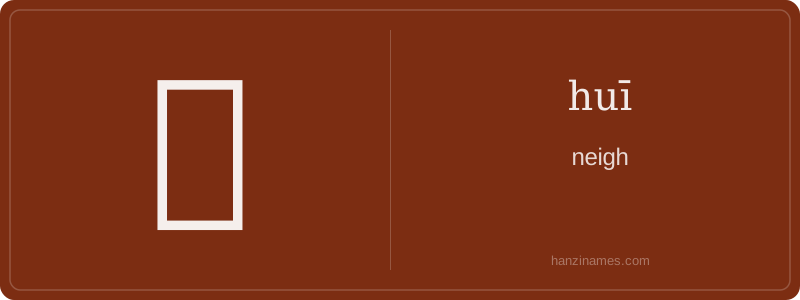
咴 is primarily used in literary and descriptive contexts — especially in historical novels, poetry, and equestrian-themed writing — to evoke the sharp, high-pitched call of a horse. While rare in spoken Mandarin today, it appears in standardized phrases like '咴咴叫' (huī huī jiào), a reduplicated form meaning 'neighing repeatedly', often found in children’s books and animal encyclopedias. It also features in regional folk songs and border literature describing Mongolian or Northwest Chinese horse culture. You’ll find it in authoritative dictionaries like the Xiàndài Hànyǔ Cídiǎn (Contemporary Chinese Dictionary), confirming its status as a standard, albeit low-frequency, character.
The character is not pictographic — it doesn’t depict a horse or mouth visually. Instead, it’s a phono-semantic compound: 口 (mouth) indicates sound production, and 咼 (guō, now pronounced huī due to sound evolution) serves as the phonetic component. This structure reflects a documented pattern in Middle Chinese phonology, where 咼 was used for syllables ending in -ui or -ei, aligning with modern huī.
Hi students! Today we’re learning 咴 (huī), a vivid onomatopoeic character that captures the sound of a horse neighing — like 'whinny!' or 'neigh!' It belongs to the 口 (kǒu, 'mouth') radical family, telling us right away it’s about vocalization. Though not common in daily speech, it appears in literature, poetry, and animal-related descriptions to add sensory realism. Its nine strokes are straightforward: start with the mouth frame (口), then add the phonetic component 咼 (guō) — but don’t worry about memorizing 咼 yet; focus first on recognizing and writing 咴 as a whole.
This character is a great example of how Chinese uses sound-based writing: the shape doesn’t picture a horse, but *imitates its voice*. That’s why it’s classified as an ‘ideographic-phonetic compound’ (形声字): 口 signals meaning (sound made by mouth), while 咼 hints at pronunciation (though modern huī diverges slightly from ancient guō). As beginners, you’ll rarely need to write 咴 for conversation — but spotting it helps deepen reading fluency, especially in classical or descriptive texts about horses, travel, or frontier life.
Don’t confuse 咴 with more common animal-sound characters like 喵 (miāo, 'meow') or 喂 (wèi, 'hey!'). Its usage is poetic and specific — think of it like the English word 'neigh' itself: precise, literary, and rarely used in casual chat. Still, mastering it builds your awareness of how Chinese encodes sound and emotion in writing. Practice writing it slowly: 口 + 咼 — remember the dot before the horizontal stroke in 咼! And always say 'huī' clearly, with a high, level first tone — like lifting your voice gently.
Example Sentences
Common Compounds
Similar Characters — Don't Mix These Up
Your First Step into Chinese Culture: Get a Chinese Name
Every journey into Chinese begins with a name. Use our free Chinese name generator to create a meaningful, personalized Chinese name that fits you perfectly.
Get My Chinese Name →