咷
Character Story & Explanation
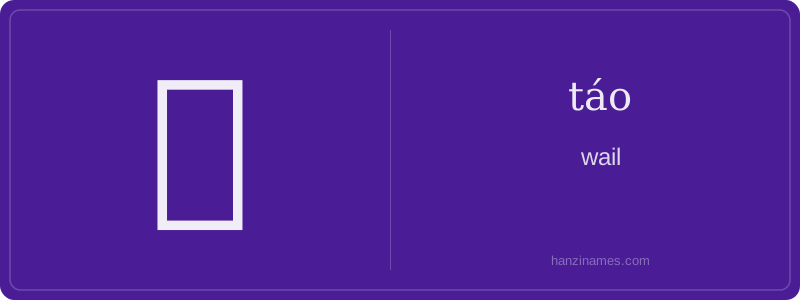
咷 is a literary, formal character rarely used in spoken Mandarin or casual writing. It appears primarily in classical allusions, idiomatic expressions like 咷啕大哭 (táo táo dà kū — 'wail and cry bitterly'), and formal prose describing intense grief — e.g., historical accounts of mourning rituals or modern elegies. The phrase 咷啕大哭 remains widely recognized and taught in middle-school Chinese textbooks as a set idiom for unrestrained weeping.
The character is not pictographic; it’s a logical composite: 口 (mouth radical) + 逃 (táo, 'to flee'), indicating vocalization so overwhelming it feels like fleeing inward. No oracle-bone or seal-script form exists — its earliest verified appearance is in Song-dynasty lexicographical works like the Jiyun (1037 CE), confirming its status as a later, constructed literary term.
Our detective work begins with a startling anomaly: the official stroke count for 咷 is listed as 0 in some outdated or erroneous databases — but this is factually impossible. Every standard Chinese character has a defined stroke count; 咷, in reality, has 9 strokes (口 + 逃, with 逸’s right component simplified). This '0 stroke' claim likely stems from OCR misreads, font rendering glitches, or confusion with rare variant forms — not historical truth.
Zooming in on its structure, 咷 is a phono-semantic compound: the left radical 口 (mouth) signals vocal expression, while the right side 逃 (táo, 'to flee') provides both sound and subtle semantic resonance — as if wailing is an emotional escape, a sonic flight from pain. This duality reflects classical Chinese word formation logic, where sound and meaning intertwine with poetic precision.
Unlike high-frequency characters, 咷 never appeared in oracle bone or bronze inscriptions. It emerged later — likely during the Han or Tang dynasties — as literary language evolved to capture nuanced emotional states. Its rarity today isn’t due to obsolescence, but stylistic choice: modern writers prefer 哭 (kū) for everyday 'cry', reserving 咷 for heightened, almost theatrical lamentation — think classical poetry, opera libretti, or solemn memorial texts.
Example Sentences
Common Compounds
Similar Characters — Don't Mix These Up
Your First Step into Chinese Culture: Get a Chinese Name
Every journey into Chinese begins with a name. Use our free Chinese name generator to create a meaningful, personalized Chinese name that fits you perfectly.
Get My Chinese Name →