咻
Character Story & Explanation
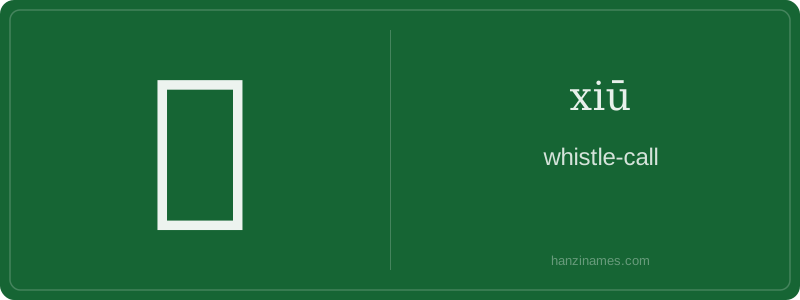
咻 is rarely used independently in modern Standard Mandarin; instead, it appears almost exclusively in reduplicated onomatopoeic forms like 咻咻 (xiūxiū), evoking rapid, rhythmic sounds—e.g., wind whistling, a fast-moving object, or even labored breathing. It appears in contemporary literature and children’s books for vivid auditory effect, and occasionally in internet slang to mimic exaggerated urgency ('咻——快跑!'). No major idioms or classical texts feature it prominently, and it is absent from the HSK vocabulary lists (HSK Level: Not included).
The character is a phono-semantic compound: 口 (kǒu, 'mouth') signals meaning related to speech/sound, while 休 (xiū, 'to rest') serves as the phonetic component—though its original meaning is unrelated. This is a common pattern in Chinese character formation: sound approximation takes precedence over semantic logic. Historically, 咻 emerged later than core characters, first appearing in Song–Yuan dynasty dictionaries as an expressive variant.
At first glance, 咻 (xiū) appears simple—a mouth radical (口) paired with a phonetic component (休). Yet it opens a window into how Chinese language encodes intentionality in sound: not just noise, but a directed vocal act—sharp, brief, and purposeful. Unlike generic verbs for 'shout' like 叫 (jiào), 咻 conveys an emphatic, often urgent call—like summoning attention across distance or cutting through silence. This reflects a cultural sensitivity to vocal tone as social punctuation: when to speak, how loudly, and with what intent.
In classical and modern usage, 咻 carries subtle performative weight—it’s rarely used alone in formal writing but thrives in onomatopoeic or expressive contexts: mimicking a whistle, a sharp warning, or even the whoosh of something fast-moving. Its brevity (9 strokes) mirrors its semantic economy: one syllable, one breath, one clear signal. This aligns with Daoist and Confucian ideals of concision—where clarity and appropriateness of speech are moral virtues.
The character embodies the Chinese worldview that sound is never neutral. From temple bells (钟声) to imperial edicts (诏书), voice carries authority, rhythm, and resonance. 咻 doesn’t just mean 'call out'—it implies agency: someone chooses to project their voice *into* space, expecting response or effect. In this light, every 咻 is a micro-contract between speaker and world—a reminder that in Chinese thought, language is action, not abstraction.
Example Sentences
Common Compounds
Similar Characters — Don't Mix These Up
Your First Step into Chinese Culture: Get a Chinese Name
Every journey into Chinese begins with a name. Use our free Chinese name generator to create a meaningful, personalized Chinese name that fits you perfectly.
Get My Chinese Name →