呙
Character Story & Explanation
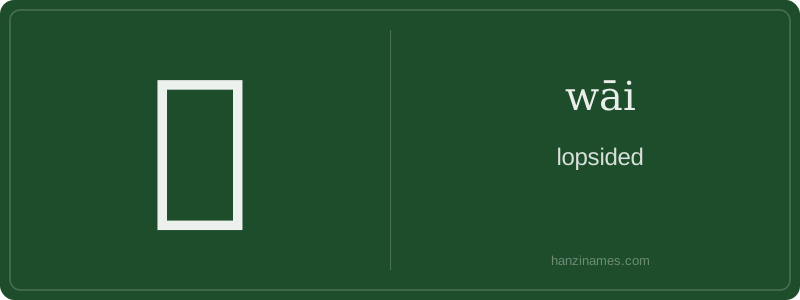
呙 is rarely used alone in contemporary Standard Mandarin, but it survives robustly in colloquial compounds — especially in northern dialects and informal speech. You’ll hear wāi most often in phrases like wāi lóu (歪楼, 'tilted building'), used online to humorously describe anything physically slanted or metaphorically unbalanced. It also appears in fixed expressions like wāi dǎ (歪打), short for 歪打正着 (wāi dǎ zhèng zháo), meaning 'to hit the target by accident' — a well-documented idiom in the Xiandai Hanyu Cidian (5th ed., 2005). This phrase illustrates how 'lopsidedness' can yield unexpected correctness.
The character 呙 has no clear pictographic origin in oracle bone or bronze inscriptions. Its earliest attested form appears in Han dynasty texts as a variant of 歪 (wāi), sharing identical meaning and pronunciation. Today, Chinese learners encounter it mainly through handwriting practice or dialect exposure — for example, when reading Beijing opera scripts or listening to northeastern Mandarin speakers describe a 'wāi guān' (歪官, 'crooked official') as a satirical term for corrupt authority.
Hi students! Let’s learn 呙 (wāi) — a character that means 'lopsided', 'crooked', or 'askew'. Though it looks simple with just 7 strokes and the mouth radical 口, don’t be misled: 呙 is *not* commonly used on its own in modern Mandarin. It appears almost exclusively as part of compound words or in dialectal speech. Its pronunciation wāi is distinctive — like the English word 'why' but with a flat first tone. Think of it as describing something visually off-center, like a tilted picture frame or a leaning tower.
This character is rarely taught in standard textbooks because it’s not in the HSK lists — meaning it’s beyond beginner/intermediate levels and not required for official exams. Still, recognizing 呙 helps you understand common spoken expressions and regional terms. Its presence in compounds often signals imbalance or deviation — not just physical, but sometimes metaphorical, like a 'lopsided argument' or 'biased view'. Understanding these nuances builds richer comprehension of natural Chinese.
Don’t confuse 呙 with similar-looking characters like 涡 (wō, 'whirlpool') or 窝 (wō, 'nest'). The key is its unique structure: 口 on top, then the lower part (冎 + 一) — a historical variant form. While it shares the 口 radical with many sound-related or mouth-related characters, 呙 is an exception: it’s not about speech or sound, but about visual asymmetry. Practice writing it slowly — stroke order matters for muscle memory and recognition!
Example Sentences
Common Compounds
Similar Characters — Don't Mix These Up
Your First Step into Chinese Culture: Get a Chinese Name
Every journey into Chinese begins with a name. Use our free Chinese name generator to create a meaningful, personalized Chinese name that fits you perfectly.
Get My Chinese Name →