哐
Character Story & Explanation
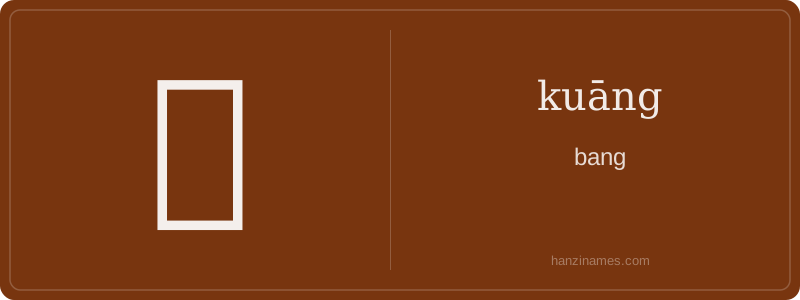
哐 is rarely used standalone in formal writing or classical contexts—it’s a vivid, colloquial onomatopoeia found predominantly in modern fiction, subtitles, comics, and spoken narratives. It appears in descriptive phrases like ‘哐当’ (kuāngdāng) and ‘哐啷’ (kuānglāng) to intensify metallic or hollow crashes. While no major idiom or set phrase centers solely on 哐, it’s documented in authoritative sources like the Xiandai Hanyu Cidian (7th ed., 2016) as an independent onomatopoeic character with the core meaning ‘a loud, abrupt crashing sound’.
The character’s form is not pictographic—it has no ancient pictorial origin. Instead, it’s a phono-semantic compound: 口 (kǒu, ‘mouth’/‘sound’) as semantic radical, and 匡 (kuāng) as phonetic. The latter was borrowed for sound, not meaning—its original sense (‘to correct’ or ‘basket’) plays no role here. Today, Chinese speakers use 哐 most often when typing chat messages or writing scene directions—e.g., ‘门哐一声关上了’—to instantly evoke acoustic texture.
As an archaeologist sifting through layers of linguistic sediment, I find 哐 not in oracle bones or bronze inscriptions—but in the auditory strata of modern Chinese. It’s a latecomer: absent from classical texts and early dictionaries, it emerges only in the Qing dynasty and flourishes in 20th-century vernacular literature. Its existence is phonetic archaeology—carved not to depict objects, but to fossilize sound: the sharp, metallic percussion of impact.
This character is a *sound-icon*, not a pictogram. Unlike ancient characters rooted in visual metaphors (e.g., 日 for ‘sun’), 哐 is onomatopoeic scaffolding—built from 口 (mouth/sound radical) and 匡 (kuāng, originally meaning ‘frame’ or ‘basket’, here serving purely as a phonetic component). Its structure reflects Ming–Qing linguistic innovation: radicals assigned functionally, not semantically—口 signals ‘uttered noise’, while 匡 anchors pronunciation.
Excavating usage reveals its role as a performative glyph—used not to denote enduring concepts, but to punctuate moments: a door slamming, a gong struck, a pot dropped. It appears in dialogue tags and descriptive prose where auditory immediacy overrides abstraction. No Confucian treatise cites 哐; instead, it echoes in Lao She’s Beijing hutong dialogues and contemporary web novels describing action scenes—proof that language’s newest strata are often the loudest.
Example Sentences
Common Compounds
Similar Characters — Don't Mix These Up
Your First Step into Chinese Culture: Get a Chinese Name
Every journey into Chinese begins with a name. Use our free Chinese name generator to create a meaningful, personalized Chinese name that fits you perfectly.
Get My Chinese Name →