哞
Character Story & Explanation
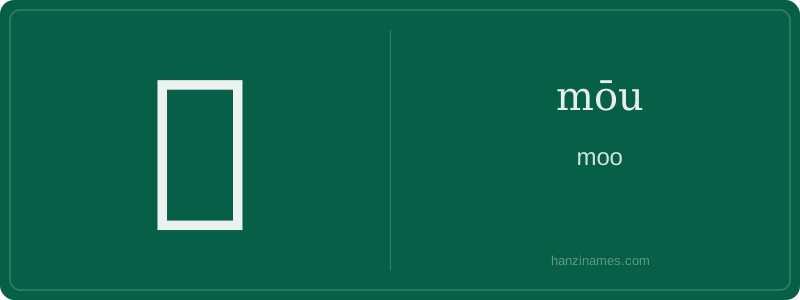
哞 is almost exclusively used as an onomatopoeic interjection for a cow’s ‘moo’, appearing in children’s literature (e.g., Little Cattle Herder picture books), animated shows like Pleasant Goat and Big Big Wolf, and rural storytelling. It rarely appears in formal writing or idioms—no classical text or modern idiom contains it. Its usage is consistently colloquial, expressive, and contextually anchored to livestock or humor.
The character is a clear phonosemantic compound: 口 (mouth radical) indicates speech/sound, and 牟 (mù), historically meaning ‘low bellow’ or ‘cattle-related resonance’, serves as the phonetic component. While 牟 itself appears in early texts like the Zuǒ Zhuàn referring to cattle sounds, 哞 as a standalone character first appears reliably in Ming–Qing vernacular fiction and dictionaries such as the Kāngxī Zìdiǎn (1716), listed explicitly as ‘the sound of cattle’.
As an archaeologist sifting through layers of linguistic sediment, I find 哞 not in oracle bones or bronze inscriptions—but in the living soil of spoken Chinese. This character emerged late in the script’s evolution, a phonosemantic compound born not of ancient ritual but of onomatopoeic necessity: the mouth radical 口 signals vocalization, while 牟 (mù) provides both sound and semantic weight—historically linked to cattle and low resonant tones in classical texts like the Shuōwén Jiězì.
Unlike pictographic ancestors such as 牛 (cow), 哞 lacks visual resemblance to its referent; it is purely auditory archaeology—a fossilized sound. Its nine-stroke form crystallized during the Song–Ming transition, when vernacular literature demanded precise notation for animal cries. No excavated stele bears it, yet it thrives in children’s books, cartoons, and rural oral storytelling—proof that linguistic artifacts need not be ancient to be authentic.
This character invites us to reconsider what counts as ‘ancient’ meaning: not carved permanence, but persistent function. 哞 endures because Chinese speakers consistently re-enact the cow’s low, vibrating call—mouth open, breath drawn deep—turning physiology into glyph. In this light, every utterance of ‘mōu’ is a ritual re-creation, a tiny excavation of embodied sound made visible through ink and intention.
Example Sentences
Common Compounds
Similar Characters — Don't Mix These Up
Your First Step into Chinese Culture: Get a Chinese Name
Every journey into Chinese begins with a name. Use our free Chinese name generator to create a meaningful, personalized Chinese name that fits you perfectly.
Get My Chinese Name →