哧
Character Story & Explanation
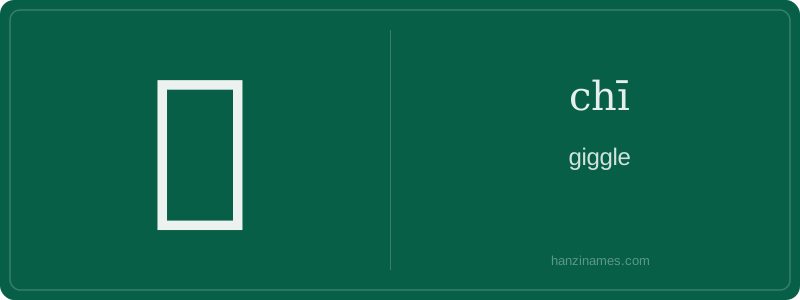
In modern Mandarin, 哧 appears primarily in expressive reduplications (e.g., 哧哧) and colloquial compounds (e.g., 哧溜、哧溜哧溜), often depicting sounds of air, sliding, or suppressed laughter. It’s common in children’s literature, comic books (manhua), and spoken dialogue to convey lighthearted derision or nervous amusement — for instance, a character might react to a silly remark with ‘哧——’ before bursting into full laughter. While not in the HSK syllabus, it appears in graded readers and oral proficiency assessments as a marker of natural fluency.
The character is not pictographic nor ancient: it emerged later in Chinese orthography as a phonosemantic compound. Its 口 (mouth) radical denotes sound production, while the phonetic component 赤 (chì, meaning 'red') provides approximate pronunciation — though the tone shifted from fourth to first tone over time. No oracle bone or bronze script forms exist; it’s a post-classical creation reflecting vernacular speech evolution.
The Chinese character 哧 (chī) is an onomatopoeic glyph representing a sharp, breathy sound — most commonly the light, suppressed laugh of giggling or snickering. Unlike English ‘giggle’, which implies playful mirth, 哧 carries a subtle nuance of spontaneity and often mild irreverence: it’s the sound you make when stifling laughter at an awkward moment or whispering a joke. Its mouth radical (口) signals vocal origin, anchoring it firmly in speech and sound expression.
This character rarely stands alone in formal writing; instead, it functions as a vivid phonetic element in reduplicated forms like 哧哧 (chīchī) or compound expressions such as 哧溜 (chīliū), where it conveys rapid, slippery motion or sound. Its usage leans heavily on auditory imagery — think of air escaping, fabric tearing, or a quick, dismissive chuckle — making it more sensory than semantic.
In Western cultural equivalents, 哣 aligns loosely with English ‘heh-heh’, ‘pfft’, or the French ‘pouah’ — all interjections that punctuate irony, embarrassment, or quiet mockery. But unlike standardized English laughter terms (e.g., ‘lol’, ‘haha’), 哧 remains distinctly oral and context-sensitive: it’s heard more than read, and its tone shifts dramatically depending on pitch, repetition, and facial expression — a reminder that in Chinese, sound characters are deeply embodied, not just textual.
Example Sentences
Common Compounds
Similar Characters — Don't Mix These Up
Your First Step into Chinese Culture: Get a Chinese Name
Every journey into Chinese begins with a name. Use our free Chinese name generator to create a meaningful, personalized Chinese name that fits you perfectly.
Get My Chinese Name →