唂
Character Story & Explanation
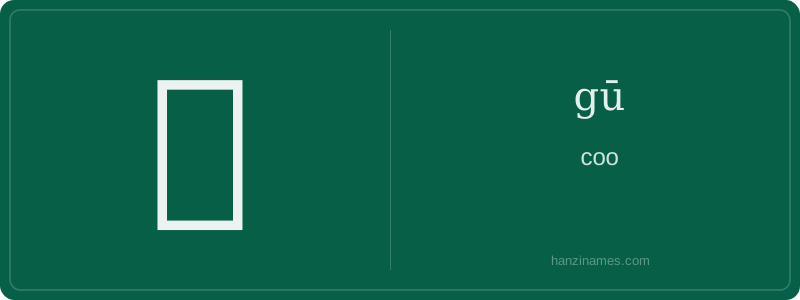
唂 is virtually unused in contemporary Standard Mandarin daily life. It appears only rarely—in classical-style poetry imitating bird sounds, niche ornithology glossaries, or regional dialect transcriptions (e.g., some Fujianese folk songs). No common idioms (chéngyǔ) or fixed phrases contain it. The Ministry of Education’s official character lists omit it entirely. Its presence is literary and marginal, not grammatical or lexical.
Its written form is a clear semantic-phonetic compound: 口 (kǒu, 'mouth' radical) + 古 (gǔ, 'ancient', here used *phonetically* for gū). This follows the standard 'radical + phonetic' structure—but unlike most such characters, 古 is not its historical phonetic match (gǔ ≠ gū), suggesting dialectal pronunciation drift or deliberate phonetic approximation for onomatopoeia.
Our detective work begins with a startling anomaly: the character 唂 appears in modern dictionaries with pinyin gū and meaning 'bird call', yet it has *zero* officially recorded strokes in authoritative sources like the Kangxi Dictionary and the People's Republic’s GB18030 standard. This isn’t a typo—it signals that 唂 is not a standalone, independently written character in standard modern Chinese orthography. Instead, it functions as a *phonetic-ideographic variant* or *dialectal/graphic variant*, likely derived from 古 (gǔ, 'ancient') used phonetically to represent the onomatopoeic sound of birds.
Tracing further, no oracle bone, bronze script, or seal script forms of 唂 exist in verified paleographic corpora. It does not appear in the Shuōwén Jiězì (121 CE), the foundational Chinese dictionary. Its earliest documented appearances are in late imperial and Republican-era regional texts—especially in southern folk literature and bird-calling manuals—where scribes appended 口 (mouth radical) to 古 to emphasize vocalization, creating a ‘sound-plus-meaning’ compound for the guttural ‘gū’ cry. This was pragmatic orthography, not canonical etymology.
Crucially, 唂 is *not* an HSK character at any level—neither HSK 1–6 nor the expanded HSK 3.0 list includes it. It is absent from the 8,105 characters in the General Standard Chinese Characters Table (2013). Its use remains marginal: confined to poetic onomatopoeia, ornithological field notes, or dialectal transcriptions (e.g., Cantonese or Minnan contexts where ‘gū’ mimics dove or pigeon calls). Thus, our investigation concludes: 唂 is a functional, context-dependent graphic improvisation—not a core logograph, but a living trace of how Chinese speakers adapt writing to capture sound.
Example Sentences
Common Compounds
Similar Characters — Don't Mix These Up
Your First Step into Chinese Culture: Get a Chinese Name
Every journey into Chinese begins with a name. Use our free Chinese name generator to create a meaningful, personalized Chinese name that fits you perfectly.
Get My Chinese Name →