唈
Character Story & Explanation
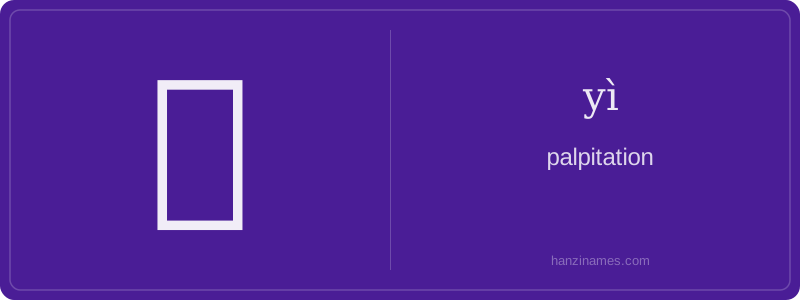
唈 is virtually obsolete in contemporary spoken Mandarin and absent from all HSK lists. It appears only in pre-modern texts—especially Tang–Song dynasty poetry and classical essays—to convey profound, inwardly restrained sorrow. For example, the Song scholar Ouyang Xiu used related phrasing (e.g., '唈然不乐') to describe dignified melancholy befitting a cultivated gentleman. No idioms containing 唈 survive in standard usage; it is never found in modern dictionaries except as a historical entry.
The character is not pictographic or ideographic in origin—it is a phonosemantic compound: the left radical 口 (kǒu, 'mouth') suggests vocal or expressive function (often linked to sighing or suppressed sound), while the right component 邑 (yì, 'city, district') serves primarily as a phonetic hint. This structure reflects its literary function: a sigh held in the throat, not uttered—a silent, internal tremor of the heart.
The character 唈 (yì) is a rare, literary word evoking the physical sensation of heart palpitations—fluttering, pounding, or trembling in the chest—not as a medical symptom alone, but as an embodied echo of deep emotion: grief, sorrow, suppressed anxiety, or moral distress. In classical Chinese thought, the heart (心 xīn) is not just an organ but the seat of consciousness, feeling, and ethical awareness; thus, 唈 reflects how inner turmoil manifests somatically, revealing a worldview where mind, body, and spirit are inseparable.
This character embodies the Confucian and Daoist understanding that emotional integrity matters for harmony—both personal and social. When one’s heart ‘palpitates’ with unexpressed sorrow or injustice, it signals a rupture in alignment with virtue (dé) or the natural order (dào). Unlike Western dualism that separates emotion from physiology, 唈 presumes their unity: to feel deeply is to *be* physically moved, and such movement demands acknowledgment, not suppression.
Though seldom used today, 唈 survives in poetic and philosophical contexts as a linguistic relic of a holistic sensibility—where language doesn’t just name feelings but enacts them through visceral resonance. Its rarity itself speaks volumes: modern Mandarin often opts for more neutral terms like 心跳 (xīntiào, 'heartbeat') or 悲伤 (bēishāng, 'sorrow'), yet 唈 endures precisely because it carries the weight of embodied conscience—a heartbeat that *matters*, morally and existentially.
Example Sentences
Common Compounds
Similar Characters — Don't Mix These Up
Your First Step into Chinese Culture: Get a Chinese Name
Every journey into Chinese begins with a name. Use our free Chinese name generator to create a meaningful, personalized Chinese name that fits you perfectly.
Get My Chinese Name →