唑
Character Story & Explanation
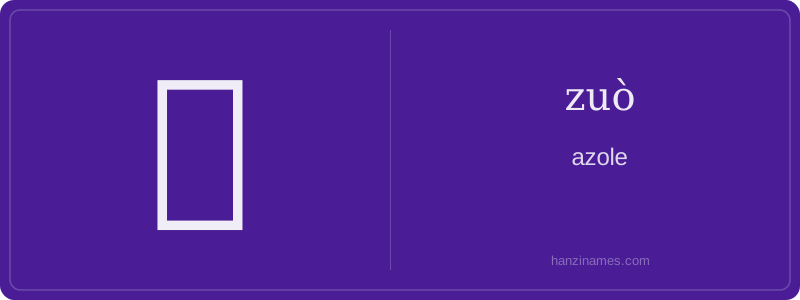
唑 appears almost exclusively in pharmaceutical, chemical, and medical regulatory contexts in contemporary China—e.g., in drug names approved by the NMPA, academic papers in journals like Chinese Journal of Medicinal Chemistry, and pharmacology textbooks. It is absent from classical texts, idioms, literature, or daily conversation. No idioms or fixed phrases contain 唑; its usage is strictly technical and post-1950s.
The character was formally standardized in the 1985 Chemical Nomenclature Principles (《化学命名原则》) by China’s National Committee on Nomenclature of Chemistry. As a phono-semantic compound, its 口 radical follows the convention for transliterated syllables (like 啡 for 'coffee'), while 昨 provides the core sound. No ancient origin exists—it is a deliberate, modern orthographic invention.
The Chinese character 唑 (zuò) is a modern scientific loan character, created in the 20th century to transliterate the chemical suffix '-azole'—a class of heterocyclic organic compounds containing nitrogen, widely used in pharmaceuticals (e.g., imidazole, triazole). Unlike most traditional Chinese characters, 唑 has no ancient literary or philosophical usage; it exists almost exclusively in technical, biomedical, and pharmaceutical contexts.
Its structure reflects linguistic adaptation: the 口 (kǒu, 'mouth') radical signals phonetic function rather than semantic meaning—a common convention for transliteration characters. The right component, 昨 (zuó), provides approximate pronunciation (zuò vs. zuó), adjusted via tone change. This mirrors how Chinese integrates foreign scientific terminology without adopting Latin script.
In contrast to Western naming—where 'azole' derives from Greek 'azōt' (nitrogen) and '-ole' (from 'alkene'), implying chemical structure—唑 carries zero etymological meaning in Chinese. Its value lies purely in phonetic fidelity and standardization across China’s regulatory, academic, and clinical domains, ensuring consistency in drug nomenclature per China’s National Medical Products Administration (NMPA) guidelines.
Example Sentences
Common Compounds
Similar Characters — Don't Mix These Up
Your First Step into Chinese Culture: Get a Chinese Name
Every journey into Chinese begins with a name. Use our free Chinese name generator to create a meaningful, personalized Chinese name that fits you perfectly.
Get My Chinese Name →