唪
Character Story & Explanation
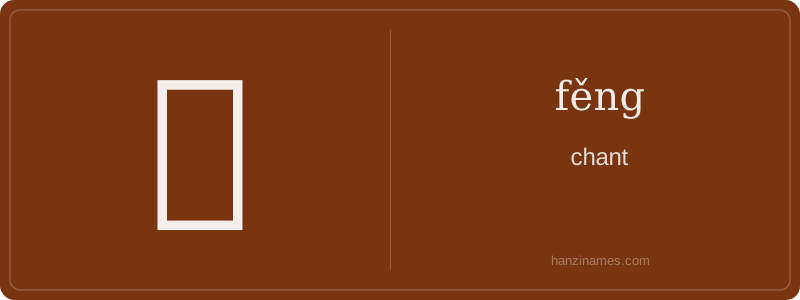
唪 is exceptionally rare in modern Mandarin and absent from all HSK levels (HSK 1–9). It appears almost exclusively in religious contexts: Daoist and Buddhist liturgical manuals, temple inscriptions, and regional folk rituals—especially in southern China and Taiwan. Documented usage includes phrases like 唱经 (fěng jīng, 'chant scriptures') and 唱咒 (fěng zhòu, 'recite mantras'). It does not occur in standard textbooks, media, or everyday conversation.
The character is not pictographic nor found in oracle bone or bronze inscriptions. Its structure combines 口 (kǒu, 'mouth') and 凤 (fèng, 'phoenix', used here phonetically for fěng). Historically, 凤 served as a phonetic loan in many characters during the Qin–Han transition. Today, Chinese speakers encountering 唱 typically see it only in temple programs, ritual handbooks, or academic studies of Chinese religion—not in daily life.
As an archaeologist sifting through layers of linguistic sediment, I uncover 唱 not as a common character—but as a rare, ritual fossil. Its form—'mouth' (口) plus 'wind' (風, simplified here to 凤's phonetic component)—suggests ancient vocalization carried by breath, not casual speech. Found in Tang dynasty Buddhist sutra manuscripts and Ming-era Daoist liturgical texts, it evokes solemn, rhythmic recitation performed by ordained clergy, not students or poets.
This character is not a relic of daily language but of sacred performance. Unlike the ubiquitous 诵 (sòng) or 读 (dú), 唱 carries tonal gravity: its pronunciation fěng (third tone) mirrors the falling-rising intonation of chant, where pitch modulates meaning and merit. Epigraphic evidence from Dunhuang cave manuscripts confirms its use exclusively in contexts requiring precise phonetic fidelity—mantras, dharanis, and esoteric invocations where mispronunciation was believed to nullify spiritual efficacy.
Modern dictionaries list it as archaic; yet it persists in living tradition. In Taiwan’s Taoist temples and Fujian’s folk religious rites, masters still 唱经 (fěng jīng)—reciting scriptures with bamboo clappers and gong accompaniment. The character thus bridges oracle-bone-era reverence for sound-as-power and contemporary practice: a sonic artifact preserved not in museums, but in the vibrating throat of the ritual specialist.
Example Sentences
Common Compounds
Similar Characters — Don't Mix These Up
Your First Step into Chinese Culture: Get a Chinese Name
Every journey into Chinese begins with a name. Use our free Chinese name generator to create a meaningful, personalized Chinese name that fits you perfectly.
Get My Chinese Name →