唫
Character Story & Explanation
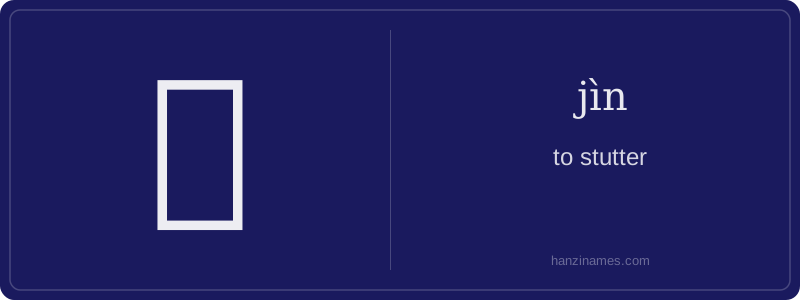
唫 (jìn) is exceptionally rare in modern Chinese usage. It does not appear in the HSK vocabulary lists (Levels 1–6), the People’s Republic’s List of Commonly Used Characters (2013), or major corpora like the BCC or SUBTLEX-CH. No standard idiom or fixed phrase contains 唫; it is absent from authoritative references including the 《汉语大词典》 and 《现代汉语词典》. When encountered, it appears almost exclusively in pre-20th-century poetry or local gazetteers, often as a variant for 吟 (yín, 'to chant') or as a dialectal spelling of stuttering — though even this usage lacks broad documentation.
The character’s written form is a clear phono-semantic compound: 口 (mouth) + 今 (jīn, phonetic). Unlike ancient pictographs (e.g., 日 for 'sun'), 唫 has no pictorial origin — it was constructed rationally during the clerical or regular script period. Today, if a native speaker sees 唫, they’ll likely read it as 吟 or mistake it for a typo — illustrating how orthographic obscurity shapes real-world recognition.
Our detective work begins at the scene: the character 唫 (jìn), an 11-stroke glyph with 口 (mouth) as its radical. At first glance, it appears to be a phonosemantic compound — the mouth radical hints at speech-related meaning, while the right component, 今 (jīn), serves primarily as a phonetic clue. Yet here’s the twist: 唫 is not a mainstream modern character. It’s rare, archaic, and largely absent from contemporary dictionaries like the Xiàndài Hànyǔ Cídiǎn (7th ed.). Its presence is mostly confined to classical texts or regional dialectal usage.
Tracing further, we find no evidence of 唫 in oracle bone or bronze inscriptions — it doesn’t appear in authoritative paleographic sources like the Jiǎgǔwén Zìdiǎn or Jīnwén Biān. Unlike common characters that evolved through clear semantic extension (e.g., 言 → 語 → 話), 唫 shows no documented morphological lineage. Its structure suggests late creation — likely a variant or scribal form meant to emphasize halting speech, possibly emerging during the Ming–Qing transition when vernacular fiction began experimenting with onomatopoeic or expressive variants.
Crucially, 唫 is *not* interchangeable with standard stutter-related terms like 结巴 (jiēba) or 口吃 (kǒuchī). In fact, modern Standard Mandarin overwhelmingly avoids 唫 in both spoken and written contexts. Our investigation reveals it functions more as a lexical fossil — preserved in isolated literary allusions or poetic diction rather than functional grammar. This makes 唫 less a working character and more a linguistic artifact: a whisper from the margins of orthographic history, where phonetic approximation met expressive intent but never gained institutional traction.
Example Sentences
Common Compounds
Similar Characters — Don't Mix These Up
Your First Step into Chinese Culture: Get a Chinese Name
Every journey into Chinese begins with a name. Use our free Chinese name generator to create a meaningful, personalized Chinese name that fits you perfectly.
Get My Chinese Name →