唳
Character Story & Explanation
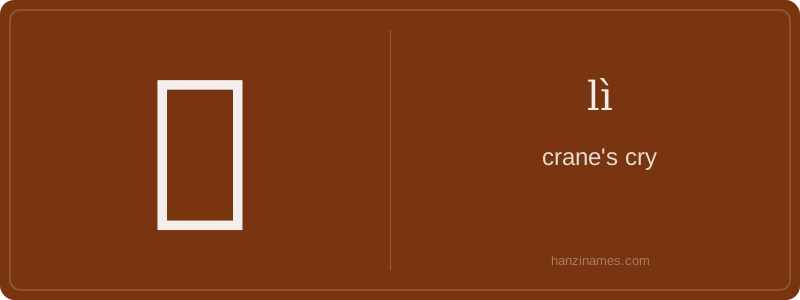
唳 is rarely used in modern spoken Mandarin but remains vital in literary, idiomatic, and historical contexts. Its most famous appearance is in the idiom 风声鹤唳 (fēngshēng hèlì), from the 383 CE Battle of Fei River—where retreating Qin troops, panicked by wind and crane cries, imagined enemy soldiers everywhere. Today, the phrase means ‘to be extremely nervous or paranoid,’ appearing in news headlines, psychological discourse, and exam texts (HSK 6+). It’s also found in classical poetry anthologies and nature writing.
The character’s form is not pictographic but phono-semantic: 口 (radical, indicating speech/sound) + 屰 (archaic phonetic component, now read nì but historically contributed the lì sound). No oracle bone or bronze script forms survive for 唳; it first appears reliably in Han dynasty bamboo slips and Shuowen Jiezi (100 CE) as a ‘crane’s cry.’ Modern usage centers on this fixed, evocative literary register—not daily conversation, but cultural memory.
唳 (lì) is not merely a phonetic description of a crane’s call—it embodies a classical Chinese aesthetic where sound carries moral and cosmic resonance. In Daoist and Confucian thought, the crane’s cry symbolizes purity, longevity, and transcendence; its sharp, piercing tone was believed to cut through worldly illusion. This character thus encodes an auditory ideal: a sound that is both natural and spiritually elevated—neither chaotic nor artificial, but harmonious with heaven’s rhythm.
The radical 口 (mouth) anchors 唳 in human perception and expression, yet the right component — 屰 (nì), meaning ‘inverted’ or ‘contrary’ — subtly suggests disruption of silence, not noise, but a deliberate, reverberant utterance. Unlike onomatopoeic words for animal sounds in English (e.g., ‘caw’, ‘honk’), 唳 is literary, almost ritualistic—used only for cranes, geese, or metaphorically for voices of integrity piercing falsehood.
In classical poetry and prose, 唳 evokes solitude, vigilance, and quiet dignity. A lone crane’s cry at dusk signals seasonal change and moral steadfastness—echoing the scholar-official’s unwavering integrity amid political turmoil. This reflects the broader Chinese worldview: nature is not background scenery but a mirror of virtue, and even a bird’s cry can be a moral utterance, resonating across landscape and literature alike.
Example Sentences
Common Compounds
Similar Characters — Don't Mix These Up
Your First Step into Chinese Culture: Get a Chinese Name
Every journey into Chinese begins with a name. Use our free Chinese name generator to create a meaningful, personalized Chinese name that fits you perfectly.
Get My Chinese Name →