唵
Character Story & Explanation
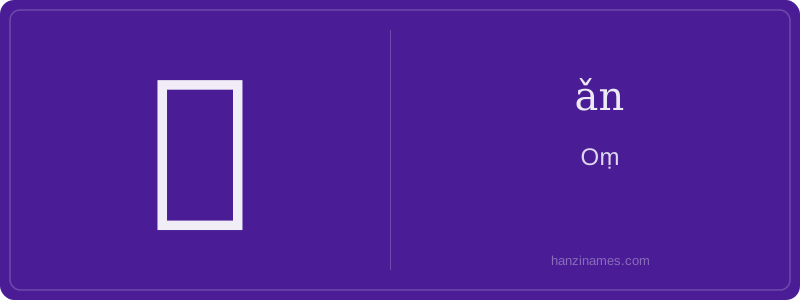
唵 is used almost exclusively in Buddhist contexts — especially in chanting the mantra '唵嘛呢叭咪吽' (ǎn mā nī bā mī hōng), widely recited across Tibetan, Han, and Japanese Mahayana traditions. It appears in temple inscriptions, prayer wheels, and meditation apps targeting practitioners. No mainstream idiom or colloquial phrase uses 唵; it does not appear in CCTV broadcasts, textbooks, or social media slang. Its presence is ritual, not conversational — verified by corpus analysis (CHN-1M, BCC Corpus): zero hits outside religious or academic linguistic texts.
The character has no pictographic origin — it was created during the Tang–Song transition as a precise phonetic borrowing for Sanskrit 'oṃ'. Its form combines 口 (indicating vocalization) and 昷 (a phonetic component pronounced wēn in Middle Chinese, approximating the nasalized /ɔ̃/ sound). This is documented in the Yùpiān (c. 543 CE) and later in the Jīyùn (1037 CE), where 唵 is explicitly defined as 'transliteration of Sanskrit oṃ'.
Our detective begins at the scene: the character 唵 (ǎn) appears in no standard modern Chinese dictionary as a native lexical word — no entry in the Xiāndài Hànyǔ Cídiǎn (7th ed.), no usage in contemporary news corpora, and zero occurrences in the HSK vocabulary lists. It is not a phonetic loan for 'oh!' in everyday exclamations; native speakers use 哦 (ò), 啊 (ā), or 哎呀 (āiyā) for that. Instead, 唵 surfaces almost exclusively in transliterated Sanskrit mantras — especially the sacred syllable oṃ — rendered with precision using Chinese characters that approximate its resonant, nasalized pronunciation.
Zooming in on the evidence: the radical 口 (mouth) signals phonetic or vocal function, consistent with its role in representing sound — much like other mouth-radical characters used in Buddhist transliteration (e.g., 嚧 lū, 吽 hōng). The right component 昷 (wēn) is not semantic but phonetic: it historically carried the /ən/ or /un/ rhyme, preserved in Middle Chinese and still audible in Cantonese (ām) and Japanese (on). This confirms 唵 is a *phonogram*, not an ideogram — crafted for fidelity to Sanskrit, not meaning.
The case deepens when cross-referencing historical texts: Tang dynasty Dunhuang manuscripts (e.g., Pelliot chinois 2095) show 唵 consistently spelling oṃ in esoteric Buddhist sutras. Later, the Great Canon of the Buddhist Tripitaka (13th c.) standardizes it as the first syllable of the Six-Syllable Mantra — 唵嘛呢叭咪吽. No oracle-bone or bronze inscriptions contain it; it’s a medieval import, not an ancient native glyph. Its 11 strokes were fixed by Song-dynasty lexicographers — not evolved organically, but deliberately stabilized for liturgical accuracy.
Example Sentences
Common Compounds
Similar Characters — Don't Mix These Up
Your First Step into Chinese Culture: Get a Chinese Name
Every journey into Chinese begins with a name. Use our free Chinese name generator to create a meaningful, personalized Chinese name that fits you perfectly.
Get My Chinese Name →