唿
Character Story & Explanation
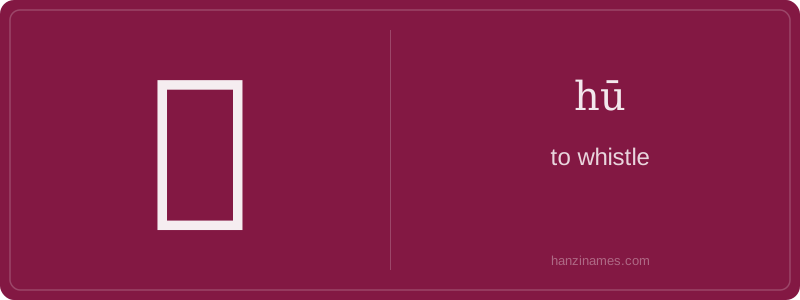
In contemporary Chinese, 唿 is almost exclusively found in fixed expressions like 唿哨 (hūshào, 'whistle') and literary or dialectal usages—especially in northern China and historical novels. It appears in classical texts such as the Shuōwén Jiězì (121 CE), defined as 'to blow sharply with the mouth' (吹聲也). Modern usage is largely limited to descriptive writing or performative speech, e.g., stage directions in Peking opera scripts indicating a sharp, signaling whistle.
The character is not pictographic; its form evolved from seal script, where 口 + 乎 combined phonetic and semantic functions. '乎' originally represented a grammatical particle but was repurposed for sound. Today, you’ll hear 唿 most authentically in Beijing hutong courtyards—where elders still use two-finger whistles to call grandchildren home at dusk, a fading but real cultural echo.
Imagine standing on a misty morning at Beijing’s Houhai Lake, where an elderly man in a gray silk jacket stands by the frozen edge, breath curling in the crisp air. He lifts two fingers to his lips—and lets out a sharp, clear hū: a whistle so piercing it startles pigeons from willow branches. This isn’t just sound—it’s intention, rhythm, and embodied communication. In Chinese, 唿 captures that precise, forceful exhalation through the mouth, often used to summon, signal, or express urgency.
The character 唿 belongs to the 口 (mouth) radical family—characters tied to vocalization, speech, or oral action. Its 11 strokes reflect both phonetic and semantic logic: the right side ‘乎’ (hū) serves as the phonetic component, while the left ‘口’ anchors meaning in oral expression. Unlike passive sounds, 唿 implies volition—a deliberate act of the body, not accidental noise.
While rarely used alone in modern Mandarin, 唿 appears powerfully in compound verbs and literary or dramatic contexts. It conveys immediacy and physicality—think of a train conductor’s sharp whistle, a shepherd’s call across hills, or a martial artist’s explosive exhalation during a strike. Its energy is visceral, its function pragmatic: to cut through silence, gather attention, or synchronize movement.
Example Sentences
Common Compounds
Similar Characters — Don't Mix These Up
Your First Step into Chinese Culture: Get a Chinese Name
Every journey into Chinese begins with a name. Use our free Chinese name generator to create a meaningful, personalized Chinese name that fits you perfectly.
Get My Chinese Name →