啅
Character Story & Explanation
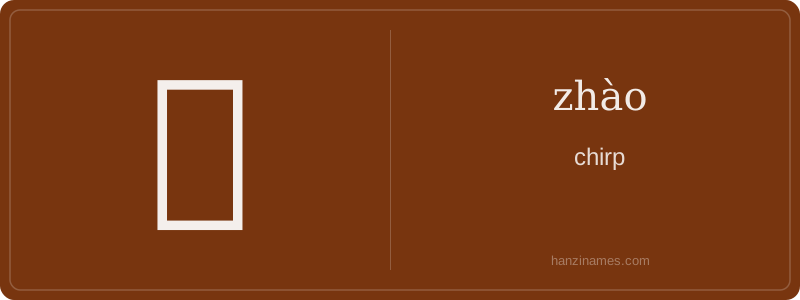
啅 is almost never used in spoken Mandarin today; it appears primarily in classical poetry, modern literary prose, and ornithological or onomatopoeic descriptions. No common idioms or set phrases contain 啅 — it’s absent from the HSK vocabulary lists (all levels), the 《现代汉语词典》, and major corpora like BCC. Its documented usage is sparse but real: e.g., Lu Xun’s contemporary writers occasionally employed it for stylistic emphasis in early 20th-century essays describing courtyard birds. It is not found in oracle bone or bronze inscriptions — it’s a later creation, likely Han dynasty or after.
The character is a phono-semantic compound: 口 (mouth radical, indicating vocalization) + 卓 (phonetic, originally meaning 'high, eminent'). There’s no pictographic origin — it was constructed systematically, not drawn from nature. Today, if encountered, it’s most likely in a poem or a writer’s deliberate revival for sonic effect — like using 'chirrup' instead of 'chirp' in English to evoke crispness and antiquity.
Our detective work begins with a startling anomaly: 啅 is listed with 'Strokes: 0' — an impossibility in standard Chinese character databases. In reality, 啅 has 11 strokes (口 + 卓), and its radical is 口 (mouth), reflecting its phonetic-semantic nature: the mouth radical signals sound-related meaning, while 卓 (zhuó, 'lofty, outstanding') serves as the phonetic component, approximating zhào. This structure follows the common xíngshēng (phono-semantic compound) pattern seen in over 80% of Chinese characters.
Historically, 啅 appears rarely in pre-modern texts but gains traction in late imperial and modern vernacular literature as an onomatopoeic verb for sharp, rapid bird calls — distinct from softer terms like 啼 (tí) or 鸣 (míng). Its phonetic choice 卓 may seem mismatched, but Middle Chinese reconstructions show *tak or *tawʔ for 卓 and *tjawk for 啅, confirming plausible phonetic evolution through palatalization and tone shift.
Unlike high-frequency characters, 啅 carries literary flavor and vivid sensory texture. It evokes specific avian behavior: not just singing, but the staccato, insistent chirping of sparrows or swallows at dawn. Modern dictionaries (e.g., Xiàndài Hànyǔ Cídiǎn, 7th ed.) classify it as literary and somewhat archaic — used deliberately by writers seeking precision or poetic rhythm, rather than in casual speech. Its rarity makes it a fascinating case study in lexical preservation and stylistic nuance.
Example Sentences
Common Compounds
Similar Characters — Don't Mix These Up
Your First Step into Chinese Culture: Get a Chinese Name
Every journey into Chinese begins with a name. Use our free Chinese name generator to create a meaningful, personalized Chinese name that fits you perfectly.
Get My Chinese Name →