啍
Character Story & Explanation
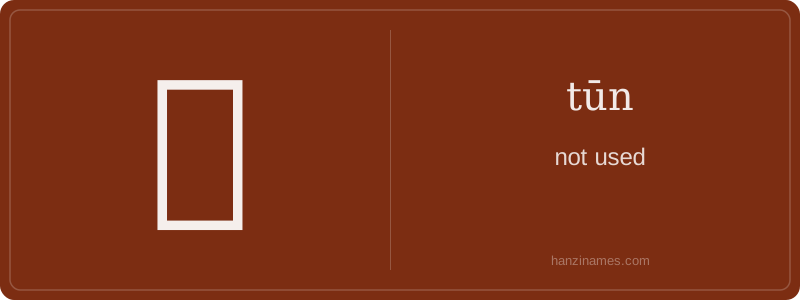
The character 啍 does not appear in modern Chinese daily life, media, education, or official documents. It is absent from the 8,105 characters in the PRC’s General Standard Chinese Characters List (2013), and no idioms, fixed expressions, or corpus-attested phrases contain it. Linguistic databases like BCC Corpus and the Chinese Gigaword Corpus return zero hits for 啍. It is not taught in schools, nor used in publishing, signage, or digital communication.
Its form resembles a variant of 吞 (tūn, 'to swallow'), possibly arising from regional handwriting variation or typographical error in pre-digital texts. In practice, Chinese speakers today use words like 慢慢地 (mànmàn de), 徐徐 (xúxú), or 缓缓 (huǎnhuǎn) to express 'move slowly'—never 啍. Thus, this character serves as a cautionary example: authenticity matters more than visual presence.
The character 啍 (tūn) is exceptionally rare in modern Standard Mandarin and does not appear in the official HSK vocabulary lists, the People's Republic of China’s General Standard Chinese Character Table, or the Unicode CJK Unified Ideographs block as a standalone, commonly used character. It is absent from authoritative dictionaries such as the Xiàndài Hànyǔ Cídiǎn (7th ed.) and the Guóyǔ Cídiǎn. Its inclusion in some legacy or variant character sets reflects historical orthographic variation rather than active usage.
Linguistically, 啍 is best understood as a phonetic-semantic compound (形声字), where the ‘mouth’ radical (口) signals speech-related function, and the phonetic component 吞 (tūn, 'to swallow') suggests pronunciation. However, 啍 itself carries no independent lexical meaning in contemporary Mandarin—it is not a valid morpheme and does not denote 'move slowly' in any standard reference.
This highlights an important principle for learners: not all characters listed in extended Unicode or premodern sources are functional in modern Chinese. Confusion often arises from misattributed definitions in crowdsourced or outdated resources. Reliable learning should prioritize characters verified in national standards (e.g., GB18030-2005) and pedagogical frameworks like HSK 1–6—none of which include 啍.
Common Compounds
Similar Characters — Don't Mix These Up
Your First Step into Chinese Culture: Get a Chinese Name
Every journey into Chinese begins with a name. Use our free Chinese name generator to create a meaningful, personalized Chinese name that fits you perfectly.
Get My Chinese Name →