啎
Character Story & Explanation
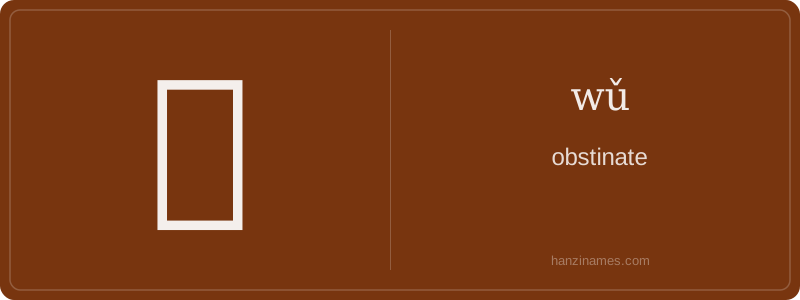
啎 is exceptionally rare in spoken Mandarin and almost absent from HSK vocabulary lists. It appears primarily in literary, historical, or formal written contexts—especially in classical texts and idioms like '违啎' (wéi wǔ), meaning 'to defy openly', or in compound '忤啎' (wǔ wǔ), used in legal or bureaucratic documents to denote deliberate insubordination. The character appears in Tang and Song dynasty memorials criticizing imperial policies, and in Ming-Qing judicial records describing officials punished for '啎旨' (wǔ zhǐ)—disobeying imperial edicts.
The character 啎 is a phono-semantic compound: the left radical 口 (kǒu, 'mouth') signals speech-related meaning, while the right component 吾 (wú, 'I, me') provides phonetic cue (though pronunciation shifted to wǔ). Its earliest attestation is in the Shuōwén Jiězì (121 CE), where Xu Shen defines it as 'not obeying; opposing' — confirming its ancient association with verbal or ideological noncompliance, not physical resistance.
The character 啎 (wǔ) embodies a subtle but potent cultural critique in Chinese thought: not raw rebellion, but the quiet, stubborn resistance of inner conviction against external pressure. Unlike Western valorizations of individual defiance, 啎 carries moral ambiguity—it may signal admirable integrity or dangerous arrogance, depending on context and authority. This reflects Confucian tension between filial obedience (xiào) and righteous remonstrance (jiàn), where disobedience is only justified when aligned with virtue and propriety (lǐ).
In classical governance, a minister who 'nì wǔ' (逆啎) — opposed the ruler’s unjust decree — risked death yet earned posthumous honor if proven right. Thus 啎 is never merely behavioral; it is an ethical litmus test. Its rarity in daily speech underscores its weight: it appears not in casual disagreement but in moments of principled rupture—where conscience overrides hierarchy, demanding courage rather than convenience.
This character reveals how Chinese ethics locates morality not in absolute rules but in relational balance. To be 啎 is to disrupt harmony (hé), yet sometimes harmony itself must be challenged to preserve deeper righteousness (yì). Modern usage retains this gravity: calling someone 啎 implies they resist not out of ignorance or laziness, but from unyielding personal standards—even when those standards clash with social expectation. It’s a linguistic marker of moral agency, not mere contrariness.
Example Sentences
Common Compounds
Similar Characters — Don't Mix These Up
Your First Step into Chinese Culture: Get a Chinese Name
Every journey into Chinese begins with a name. Use our free Chinese name generator to create a meaningful, personalized Chinese name that fits you perfectly.
Get My Chinese Name →