啐
Character Story & Explanation
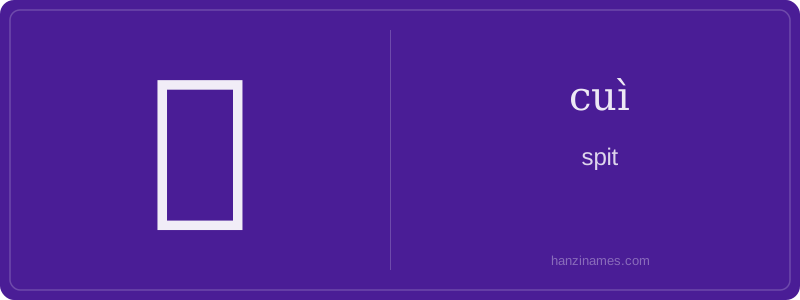
啐 is rarely used in modern Mandarin daily speech but appears frequently in classical texts, traditional opera, and literary dialogue to convey sharp, contemptuous rejection — often accompanied by an actual spit or dramatic head-turn. It appears in the idiom 啐不及防 (cuì bù jí fáng), a variant of 猝不及防 ('sudden and unexpected'), though this usage is archaic and largely replaced by 猝. Historically, it was documented in the Shuōwén Jiězì (121 CE) as 'spitting to reject evil spirits' — a ritual act during exorcisms or funerary rites.
The character is not pictographic; its form evolved from seal script where 口 remained clear and 卒 (originally depicting a soldier's cap and feet) was simplified as a phonetic component. No oracle bone form exists for 啐 — it emerged later, during the Warring States period, as a specialized verb for ritual or emotional spitting.
Our detective begins at the crime scene: the character 啐, pronounced cuì. At first glance, it’s a mouth (口) doing something forceful — and indeed, its core meaning is 'to spit' or 'to eject sharply from the mouth.' The right side, 卒, is not a phonetic red herring; in Middle Chinese, it contributed to the sound *tsʰuət*, aligning closely with modern cuì. This isn’t random scribble — it’s a semantic-phonetic compound (形声字), where 口 signals oral action and 卒 anchors pronunciation.
Zooming in on the radical: 口 appears in over 1,000 characters related to speech, taste, breath, or expulsion — think 吐 (tǔ, to vomit), 咳 (ké, to cough), and 啼 (tí, to cry out). 啐 belongs squarely in this 'mouth-in-motion' family. Its 11 strokes follow a strict order: start with the mouth frame, then build 卒 stroke-by-stroke — no shortcuts, no improvisation. This structure reflects classical Chinese orthographic discipline, not folk etymology.
While 啐 never made it into the HSK curriculum (HSK Level: Not included), its presence is vivid in classical literature and theatrical dialogue. It carries emotional weight — contempt, disgust, or ritual dismissal — far beyond mere physiology. In Ming-Qing vernacular novels like The Plum in the Golden Vase, 啐 punctuates scornful retorts. Today, it survives most robustly in opera libretti and regional dialect expressions, where vocalized spitting remains a culturally coded gesture of defiance or disdain.
Example Sentences
Common Compounds
Similar Characters — Don't Mix These Up
Your First Step into Chinese Culture: Get a Chinese Name
Every journey into Chinese begins with a name. Use our free Chinese name generator to create a meaningful, personalized Chinese name that fits you perfectly.
Get My Chinese Name →