啖
Character Story & Explanation
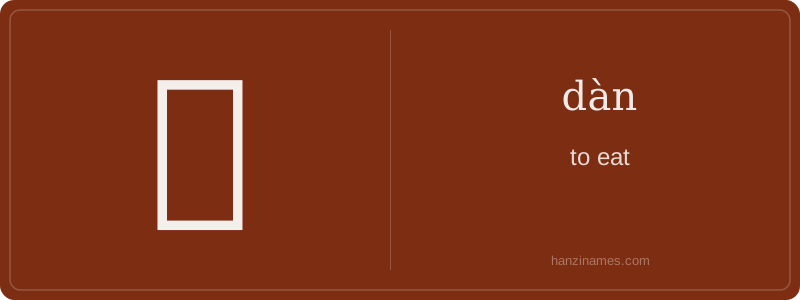
In modern Mandarin, 啖 is literary and formal—rare in speech but common in written idioms, historical novels, and classical allusions. It appears in the idiom '啖以重利' (dàn yǐ zhòng lì), meaning 'to entice with great profit,' documented since the Records of the Grand Historian (c. 94 BCE). Contemporary usage survives in journalism ('啖之以利'), academic writing, and food criticism describing rich, indulgent flavors.
The character is not pictographic—it evolved from seal script where 口 (mouth) combined with 旦 (dawn, used phonetically). No oracle bone form exists; its earliest attestation is in Warring States bamboo texts. Today, Chinese learners encounter it mainly through idioms or when reading historical fiction—e.g., a general '啖血为盟' (swearing blood oaths over shared wine).
As an archaeologist brushing dust from a Han dynasty bamboo slip, I find 啖 inscribed in a medical text prescribing herbal decoctions—'to consume medicinally.' Its mouth radical (口) anchors it to oral action, while the 'Dan' phonetic component (旦) hints at dawn—the time of first nourishment. This isn’t mere eating; it’s deliberate, often ritualized or therapeutic ingestion, preserved across centuries in pharmacopoeias and stele inscriptions.
Excavations at Mawangdui revealed early uses of 啗 (variant form) in dietary prescriptions for nobles—suggesting social nuance: 啖 implied controlled, intentional intake, unlike casual 食 or vulgar 吃. The character appears in legal documents too: ‘啖毒’ (ingesting poison) carried severe penalties, revealing how precisely classical Chinese distinguished modes of consumption.
Unlike modern colloquial verbs, 啖 never meant 'to chew' or 'to taste'—it always denoted swallowing whole or consuming substances with purpose: medicine, poison, or symbolic offerings. Its rarity in oracle bone or bronze inscriptions confirms it emerged later, during the Warring States period, as textual medicine and bureaucratic record-keeping intensified—making 啖 a lexical artifact of China’s early scientific and administrative awakening.
Example Sentences
Common Compounds
Similar Characters — Don't Mix These Up
Your First Step into Chinese Culture: Get a Chinese Name
Every journey into Chinese begins with a name. Use our free Chinese name generator to create a meaningful, personalized Chinese name that fits you perfectly.
Get My Chinese Name →