啜
Character Story & Explanation
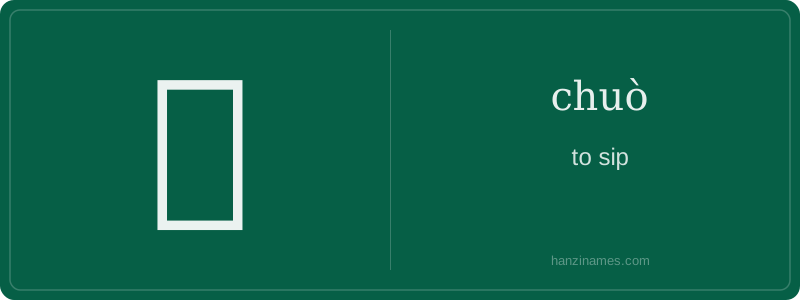
啜 is rarely used in casual spoken Mandarin today—it’s largely literary or formal. You’ll encounter it in written contexts: essays describing someone ‘sipping tea’ (啜茗), news reports quoting a person ‘sobbing quietly’ (啜泣), or historical novels depicting scholars 啜酒 (sipping wine). It appears in the classic idiom 啜菽饮水 (chuò shū yǐn shuǐ), from the *Mencius*, praising contentment with simple fare—literally ‘sipping soy broth and drinking water’.
The character is not pictographic; its form evolved from seal script. The left 口 is the mouth radical, standard for oral actions. The right side 辶+叕 is a phonetic loan—originally related to 辍 (to cease), suggesting rhythmic, interrupted action—fitting for sipping. No oracle bone or bronze inscription evidence exists for 啜; it first appears reliably in Han dynasty texts as a variant for refined drinking.
啜 (chuò) embodies a quiet, deliberate act of drinking—often tea, soup, or wine—not as mere sustenance but as a mindful ritual. Its radical 口 (mouth) grounds it in bodily experience, while the phonetic component 辍 (chuò, 'to pause') subtly suggests sipping with pause and presence. In classical Chinese thought, such small acts reflect harmony between human action and natural rhythm: one does not gulp, but savors, aligning breath, gesture, and intention.
This character reveals how Chinese worldview embeds philosophy in everyday verbs. Unlike English ‘drink’, which is neutral and often instrumental, 啜 conveys refinement, restraint, and emotional texture—think of someone啜泣 (chuòqì, ‘sobbing softly’) or 啜茗 (chuòmíng, ‘sipping tea’). The act becomes expressive: sorrow is not wailed but quietly swallowed; joy is not shouted but tasted sip by sip.
Historically, 啜 appears in texts like the *Zuo Zhuan* and Tang poetry to denote refined consumption—especially of wine or medicinal broths—marking social grace and self-cultivation. Its persistence in modern literary and formal registers (e.g., news reports, essays) shows how language preserves aesthetic values: even in motion, there is elegance; even in intake, there is introspection. To 啜 is to inhabit a moment fully—with mouth, mind, and mood aligned.
Example Sentences
Common Compounds
Similar Characters — Don't Mix These Up
Your First Step into Chinese Culture: Get a Chinese Name
Every journey into Chinese begins with a name. Use our free Chinese name generator to create a meaningful, personalized Chinese name that fits you perfectly.
Get My Chinese Name →