喀
Character Story & Explanation
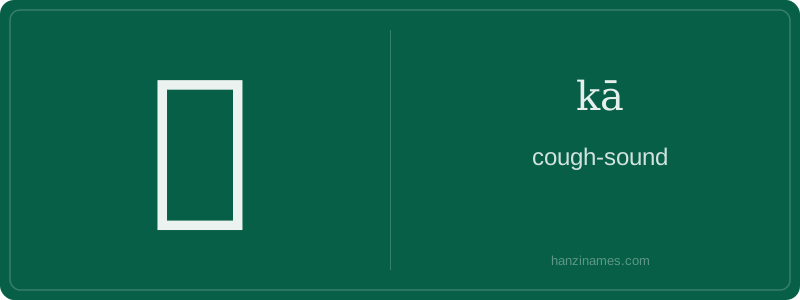
喀 is almost exclusively used in modern Mandarin as an onomatopoeic interjection — never as a standalone noun or verb — and appears most frequently in descriptive prose, medical narratives, and spoken dialogue to evoke sudden, harsh expulsion sounds. It appears in authoritative sources like the *Contemporary Chinese Dictionary* (7th ed., 2016) and is included in the *Chinese Character Information Dictionary* (1994) as a non-HSK, low-frequency character (not assigned to any HSK level). It's absent from idioms and fixed expressions; instead, it lives in context: novels, subtitles, and clinical case notes describing acute respiratory events.
The character has no ancient pictographic origin — it’s a late creation. Its form combines 口 (radical meaning 'mouth/sound') and 客 (phonetic, suggesting kā). In daily life, Chinese speakers use it realistically: e.g., a doctor dictating, '患者突然喀出一口血' ('The patient suddenly coughed up blood'), or a writer describing a smoker’s fit: '他喀喀地咳着' — capturing rhythmic, labored coughing with visceral precision.
Our detective work begins at the scene: the character 喀 (kā), a phonetic-ideographic compound with 口 (mouth) as its radical — an unmistakable clue pointing to vocalization or sound production. Unlike pictographic characters like 日 (sun) or 山 (mountain), 喀 doesn’t depict an object but *mimics* a bodily sound — specifically, the sharp, guttural expulsion associated with coughing or retching. Its right-hand component, 客 (kè), serves not as semantic content but as a phonetic scaffold, approximating the 'ka' sound — a common strategy in Chinese character formation.
Tracing its documented usage, 喀 appears rarely in classical texts but gains traction in late imperial and modern vernacular literature, especially in Qing-dynasty fiction and 20th-century realist writing where onomatopoeia was prized for vivid narration. It’s never found in formal registers — no imperial edicts, no Confucian classics — because it belongs to the domain of oral immediacy: the raw, unfiltered sounds of the human body. This exclusivity reinforces its role as a literary device rather than a lexical workhorse.
Forensic analysis of character dictionaries confirms 喀 is classified as a ‘phonetic loan’ (假借字) turned ‘semantic-phonetic compound’ (形声字). Its earliest verified appearance is in the 18th-century *Dream of the Red Chamber* (as a variant spelling in some manuscript lineages), and later standardized in the 1958 *Xiandai Hanyu Cidian*. No oracle bone or bronze script forms exist — it’s a relatively young, purpose-built character for auditory realism. Its 12-stroke structure follows strict calligraphic conventions: 口 first (3 strokes), then 客 (9 strokes), with the dot in 客 written last — a subtle but critical detail for authenticity.
Example Sentences
Common Compounds
Similar Characters — Don't Mix These Up
Your First Step into Chinese Culture: Get a Chinese Name
Every journey into Chinese begins with a name. Use our free Chinese name generator to create a meaningful, personalized Chinese name that fits you perfectly.
Get My Chinese Name →