喃
Character Story & Explanation
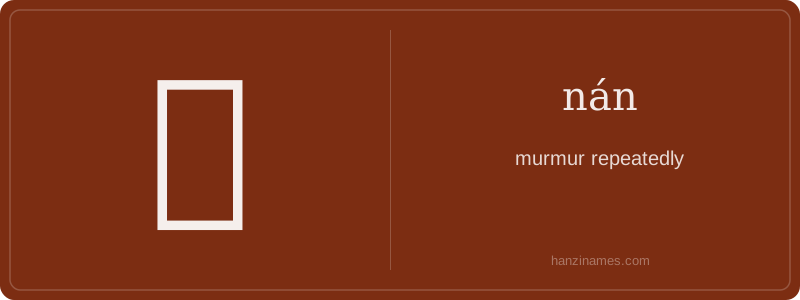
喃 is overwhelmingly used in the reduplicated form 喃喃 (nánnán), appearing in classical poetry, vernacular novels, and modern spoken Mandarin. It’s documented in the 14th-century classic Water Margin (Shuǐhǔ Zhuàn) to describe characters muttering anxiously before battle. Today, it’s common in psychological descriptions ('he kept喃喃自语' — 'he kept talking to himself quietly') and media portrayals of trauma or introspection. Teachers and therapists may note 喃喃 as a behavioral cue in children or neurodivergent individuals.
The character is not pictographic; its origin lies in Han dynasty phonetic borrowing. 南 (nán) was borrowed for sound, and 口 added for semantic clarity. No oracle bone or bronze script forms exist for 喃—it emerged later in clerical script. In daily life, Chinese speakers most often encounter it in phrases like 喃喃自语 (nánnán zìyǔ) or in subtitles depicting quiet, repetitive speech—never as a standalone verb.
The Chinese character 喃 (nán) conveys the soft, repetitive vocalization of words—often under one’s breath—without full articulation or intent to be heard. It evokes quiet self-talk, anxious rehearsing, or absentminded recitation, like murmuring a prayer or counting steps silently. Unlike English 'mumble', which implies incoherence or laziness, 喃 carries neutral or even tender connotations: a parent soothing a child with rhythmic sounds, or someone comforting themselves during stress.
In linguistic terms, 喃 is a phono-semantic compound: the 口 (mouth) radical signals speech-related meaning, while the phonetic component 南 (nán) provides pronunciation cues. It appears almost exclusively in reduplicated form 喃喃 (nánnán), reinforcing the iterative, low-volume quality. This doubling is grammatically essential—喃 alone is rare in modern usage outside poetic or literary contexts.
Western equivalents include 'murmur', 'mutter', and 'mumble', but none capture 喃’s cultural nuance fully. English ‘murmur’ suggests gentle sound (e.g., a stream), while ‘mutter’ implies annoyance. 喃 is more intimate and rhythmically deliberate—akin to a Buddhist monk’s quiet chant or a student whispering vocabulary before an exam. It reflects Confucian-influenced values of restraint: speaking softly, not for attention, but for inner grounding.
Example Sentences
Common Compounds
Similar Characters — Don't Mix These Up
Your First Step into Chinese Culture: Get a Chinese Name
Every journey into Chinese begins with a name. Use our free Chinese name generator to create a meaningful, personalized Chinese name that fits you perfectly.
Get My Chinese Name →