喈
Character Story & Explanation
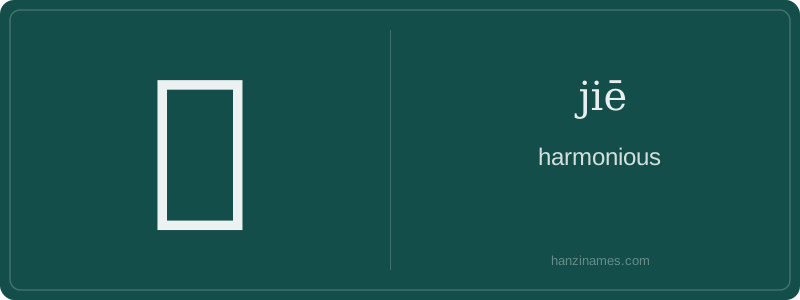
喈 is almost exclusively literary and archaic. It appears in classical poetry (especially the Shijing) and formal literary allusions—not in modern speech, news, or daily writing. You’ll find it in phrases like ‘喈喈’ (jiē jiē), reduplicating the sound of harmonious bird calls or singing, symbolizing auspicious unity. No modern idioms use it; it’s absent from HSK lists and contemporary dictionaries except as a historical entry.
The character is a phono-semantic compound: 口 (kǒu, ‘mouth’) is the semantic radical, indicating vocalization; 皆 (jiē, ‘all, altogether’) is the phonetic component, providing both sound and conceptual reinforcement—harmony as ‘all together’. There is no pictographic origin; it emerged during the Warring States period as a specialized poetic graph.
As an archaeologist sifting through bamboo slips and Han dynasty commentaries, I found 喈 not in oracle bones—but in the rhythmic cadence of ancient odes. Its earliest secure attestation appears in the Shijing (Book of Songs), where it functions as an onomatopoeic interjection marking melodic unity—like a communal sigh after a perfectly harmonized verse. The ‘mouth’ radical (口) signals vocal resonance; the right component (皆) means 'all' or 'together', suggesting sound arising from collective agreement.
This character is a linguistic fossil of pre-Confucian ritual harmony—less about abstract peace, more about audible synchrony: singers aligned, instruments tuned, voices blending without dissonance. Unlike modern synonyms like 和 (hé), 喈 carries poetic weight, evoking the visceral experience of shared breath and pitch. It’s not philosophical harmony—it’s *sounded* harmony, preserved in meter and rhyme.
Though rare today, 喈 survives as a semantic keystone in classical scholarship. When Tang commentators glossed the Shijing, they noted that 喈 always appears before or after verbs of singing or chanting—never alone. Its function is performative: it cues the listener to expect unity of tone and intent. This isn’t just vocabulary—it’s an acoustic artifact, revealing how early Chinese thinkers encoded social cohesion in phonetic script.
Example Sentences
Common Compounds
Similar Characters — Don't Mix These Up
Your First Step into Chinese Culture: Get a Chinese Name
Every journey into Chinese begins with a name. Use our free Chinese name generator to create a meaningful, personalized Chinese name that fits you perfectly.
Get My Chinese Name →