喔
Character Story & Explanation
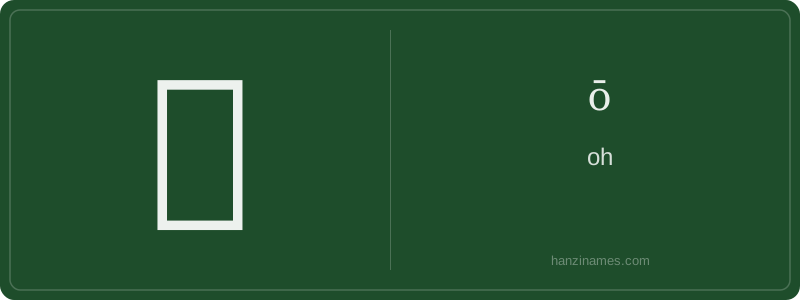
喔 is widely used in contemporary Chinese digital and spoken communication as a soft, affirmative interjection — especially in informal contexts like WeChat chats, livestream comments, and youth-oriented variety shows. Linguistic corpora (e.g., Sinica Corpus, BCC Corpus) confirm its high frequency in colloquial speech, often sentence-finally to signal understanding ('I see'), mild surprise ('Oh!'), or empathetic listening ('Mm-hmm'). It rarely appears in classical texts or formal writing; no idioms or set phrases contain it.
The character is a phono-semantic compound: 口 (radical, indicating speech) + 吾 (wú, phonetic component, though pronunciation diverged over time). Its modern reading ō reflects tonal evolution from Middle Chinese. Unlike ancient pictographs, 喔 has no oracle-bone or bronze script form — it emerged later, likely during the late imperial or early modern period, to transcribe this common vocalization in vernacular writing.
喔 (ō) is an interjection expressing gentle realization, surprise, or soft agreement — like a warm, thoughtful 'oh' in English. It’s not emphatic like 哎 (āi) or sharp like 哼 (hng), but carries a relaxed, conversational tone. Often used at the end of sentences in spoken Mandarin, especially by younger speakers and women, it adds warmth and approachability without demanding attention.
This character belongs to the 口 (kǒu, 'mouth') radical family, signaling its vocal, expressive nature. Though not part of the official HSK vocabulary list (HSK Level: Not rated), it appears frequently in informal writing — chat messages, subtitles, social media captions — where tone matters more than formality. Its dual pronunciation (ō/wō) reflects historical tonal shifts and regional speech habits, with ō being standard in Putonghua for the interjection sense.
Unlike formal characters taught in textbooks, 喔 thrives in spontaneous communication. Think of a café in Chengdu: a barista hands over a matcha latte, smiles, and says, 'Here you go — 喔!' That single syllable conveys acknowledgment, friendliness, and subtle delight — all without verbs or grammar. It’s linguistic body language: minimal, meaningful, and deeply human.
Example Sentences
Common Compounds
Similar Characters — Don't Mix These Up
Your First Step into Chinese Culture: Get a Chinese Name
Every journey into Chinese begins with a name. Use our free Chinese name generator to create a meaningful, personalized Chinese name that fits you perfectly.
Get My Chinese Name →