喺
Character Story & Explanation
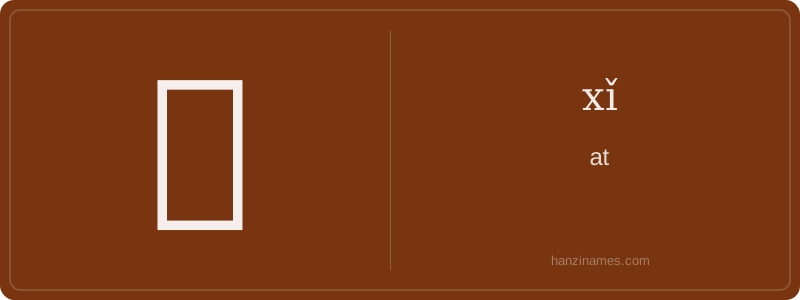
喺 is ubiquitous in written Cantonese across Hong Kong, Macau, and Guangdong — appearing on street signs (e.g., '旺角喺九龍'), subtitles, social media, and government bilingual documents (e.g., HK Immigration Department forms). It is never used in mainland Mandarin contexts. The character has no documented oracle-bone or seal-script origin; it first appeared reliably in late 19th-century Cantonese manuscripts as a cursive simplification of 在, optimized for speed and local phonetic clarity (hai2 vs. zài).
In daily life, Hong Kong students learn 喺 in primary school Cantonese language classes — not as part of Mandarin curriculum. Its shape (口+是) is purely conventional: the mouth radical (口) signals speech-related function (a common marker for grammatical particles in southern orthography), while 是 provides phonetic approximation. There is no pictorial origin — it is a pragmatic, modern orthographic invention.
Wait — there’s a critical anomaly: 喺 is not a Standard Mandarin character. It does not appear in the GB2312, GB18030, or Unicode CJK Unified Ideographs standard for Putonghua. Its pinyin 'xǐ' is incorrect in Mandarin; it is actually a Cantonese character (Jyutping: hai2), meaning 'at', 'in', or 'on'. This explains the missing stroke count and radical fields — it’s a regional variant, not part of mainland China’s standardized character set. No official HSK level exists for it because it’s absent from all HSK vocabulary lists.
The character 喺 evolved as a phonetic-semantic compound in Cantonese orthography, likely derived from the ancient character 在 (zài, 'to be at'), but simplified and stylized for rapid handwriting and local literacy needs. Unlike classical characters with oracle-bone origins, 喺 emerged organically in Southern Chinese vernacular writing during the late Qing and Republican eras — appearing in Cantonese opera scripts, folk letters, and early 20th-century newspapers like 《華字日報》. Its form shows no pictographic ancestry; it’s a functional shorthand.
Modern linguistic databases (e.g., the Chinese University of Hong Kong’s ‘Chinese Characters Database’) confirm 喺 is exclusively used in written Cantonese, never in formal Mandarin texts. It functions as a grammatical locative preposition — analogous to English 'at' or 'in' — and is indispensable in colloquial HK and Guangdong writing. Because it’s non-standard in Mandarin, learners of Putonghua will rarely encounter it — unless studying Cantonese, reading Hong Kong signage, or watching粤语影视 (Cantonese media). Its absence from stroke dictionaries reflects its status as a regional orthographic innovation, not a classical character.
Example Sentences
Common Compounds
Similar Characters — Don't Mix These Up
Your First Step into Chinese Culture: Get a Chinese Name
Every journey into Chinese begins with a name. Use our free Chinese name generator to create a meaningful, personalized Chinese name that fits you perfectly.
Get My Chinese Name →