喼
Character Story & Explanation
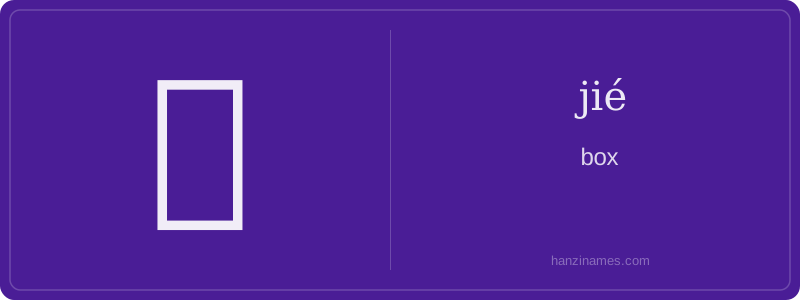
喼 is widely used in Hong Kong, Macau, and Guangdong in informal and commercial contexts to mean 'box' — especially in logistics, packaging, and everyday speech. It appears in phrases like '紙喼' (paper box) and '鐵喼' (metal box), and is standard in Hong Kong’s bilingual government documents, postal services, and retail labeling. Unlike Mandarin’s 箱 (xiāng), 喼 carries no formal HSK status but is indispensable in Cantonese-dominant domains.
The character is a phono-semantic compound: 口 (radical, hinting at spoken usage) + 吉 (jí, serving as a phonetic component approximating Cantonese jié). It does not appear in oracle bone or bronze inscriptions; its earliest documented use dates to late Qing/early Republican era Cantonese publications and handwritten ledgers — a practical innovation, not an ancient glyph.
The character 喼 (jié) is a Cantonese-specific written form meaning 'box' — not part of standard Mandarin orthography. Its existence reveals how Chinese writing accommodates regional linguistic realities: when spoken Cantonese uses a native word (jié) for 'box', scribes adopted this character to represent it phonetically and semantically, even though it’s absent from mainland textbooks. This reflects the pragmatic, bottom-up evolution of Chinese script — shaped by daily speech, not just top-down standardization.
Unlike classical characters rooted in ancient pictographs or ideograms, 喼 emerged from vernacular necessity. Its radical 口 (mouth) signals phonetic association — common in phono-semantic compounds — while the right side 吉 (jí, 'auspicious') approximates the Cantonese pronunciation jié. This shows how Chinese speakers creatively repurpose existing characters to fill lexical gaps, honoring both sound and cultural resonance over strict etymological purity.
This character embodies the living, adaptive nature of Chinese writing: not a frozen relic, but a responsive tool. In Hong Kong and Guangdong, 喼 appears on shipping labels, warehouse inventories, and colloquial signage — proof that literacy includes local fluency, not just HSK-aligned forms. It invites learners to see Chinese as a constellation of interconnected varieties, where meaning is anchored in community use, not just dictionary authority.
Example Sentences
Common Compounds
Similar Characters — Don't Mix These Up
Your First Step into Chinese Culture: Get a Chinese Name
Every journey into Chinese begins with a name. Use our free Chinese name generator to create a meaningful, personalized Chinese name that fits you perfectly.
Get My Chinese Name →