喿
Character Story & Explanation
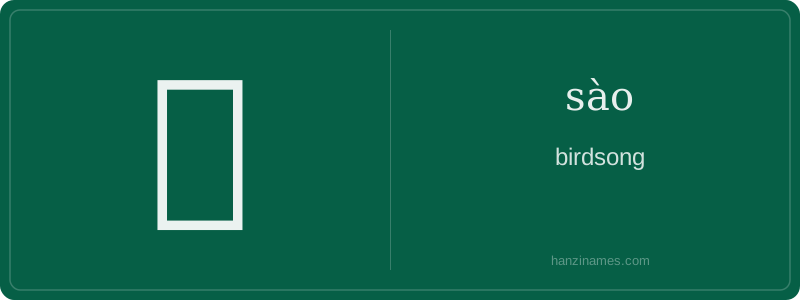
喿 (sào) is virtually unused as an independent character in modern Mandarin. It does not appear in the HSK syllabus, nor in any contemporary dictionary as a standalone word. Its sole verified role is as a phonetic component in characters like 噪 (zào, noise), 燥 (zào, dry), and 操 (cāo, to manipulate). No classical idioms or literary phrases use 喿 alone; it’s absent from the Shuōwén Jiězì (121 CE) as a head character. In practice, Chinese learners encounter it only when dissecting compound characters — never in speech or writing.
The character’s form — 口 over three 木 — is a clear, documented phonetic construction from the Qin–Han transition period. It was designed to represent the *sào* sound, not to depict birds literally. While its meaning ('chirping') is glossed in some modern dictionaries, this reflects later semantic back-association — not original intent. Today, Chinese people see 喿 only in calligraphy analysis or character etymology classes.
Our detective work begins with the character 喿 (sào), a rare but structurally revealing glyph. At first glance, it appears complex — 13 strokes, dominated by the 口 (mouth) radical at the top. But look closer: it’s actually a triple repetition of 木 (mù, tree) beneath 口, forming a symmetrical, stacked pattern. This isn’t arbitrary: in ancient Chinese orthography, reduplication often signaled intensity or repetition — here, evoking the rapid, layered, overlapping sound of many birds calling at once.
Historically, 喿 never stood alone as a common word in classical texts. Instead, it functioned almost exclusively as a phonetic component — a ‘sound clue’ embedded within more frequent characters like 操 (cāo, to handle), 燥 (zào, dry), and 噪 (zào, noise). Its pronunciation sào (with falling tone) was preserved in these derivatives, even as its independent meaning faded from daily use. This makes 喿 a linguistic fossil: silent in isolation, yet vocal in the words it helped shape.
Unlike pictographic characters like 日 (sun) or 山 (mountain), 喿 has no oracle-bone or bronze script attestation as an independent logogram. Its earliest secure appearance is in seal script (c. 3rd century BCE), already in its ‘triple-wood-under-mouth’ form. Scholars agree it was deliberately constructed — not drawn from nature, but engineered for phonetic utility. That makes it a fascinating case study in how Chinese writing evolved from depiction to abstraction, where sound and structure conspire to encode meaning indirectly.
Example Sentences
Common Compounds
Similar Characters — Don't Mix These Up
Your First Step into Chinese Culture: Get a Chinese Name
Every journey into Chinese begins with a name. Use our free Chinese name generator to create a meaningful, personalized Chinese name that fits you perfectly.
Get My Chinese Name →