嗀
Character Story & Explanation
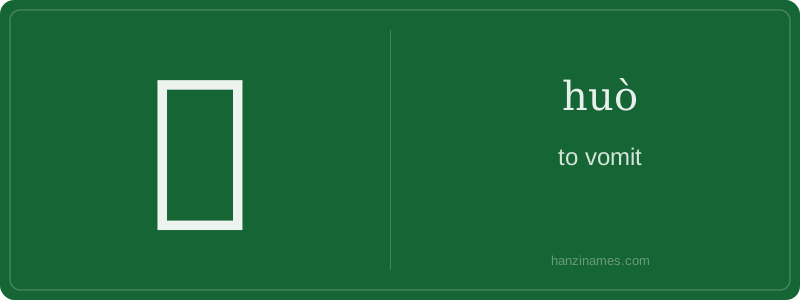
Historically, 嗀 appears in pre-modern medical and literary texts — such as the Song dynasty’s Tai Ping Sheng Hui Fang (‘Taiping Sacred Prescriptions’) — where it denotes forceful vomiting in diagnostic descriptions. However, it has been largely replaced by 呕, 吐, or 噦 in both spoken and written Modern Standard Chinese. You won’t find 嗀 in any HSK word list, contemporary news, or social media. No idioms (chengyu) include it, and it’s absent from the People’s Republic’s 2013 List of Commonly Used Standard Chinese Characters.
The character is not a pictograph or ancient oracle-bone glyph. Rather, it’s a later phonosemantic compound: 口 (mouth) + 貉 (a phonetic hint for huò/hè). Since 貉 originally refers to a raccoon dog — unrelated to vomiting — this is purely a sound-based borrowing. In daily life, Chinese people simply say ‘我吐了’ (Wǒ tǔ le) or ‘他干呕’ (Tā gān’ǒu) — never ‘他嗀了’. So if you hear or read 嗀, it’s likely in a historical reenactment, classical poetry annotation, or specialized academic context.
Hi there! Let’s talk about the character 嗀 (huò), which means 'to vomit'. It’s a relatively rare and literary character — you’ll almost never see it in everyday texting, casual speech, or beginner textbooks. Unlike common synonyms like 吐 (tǔ) or 呕 (ǒu), 嗀 carries a formal, sometimes archaic or medical tone. It appears mostly in classical texts, traditional medicine literature, or highly descriptive writing — think of a Tang dynasty poem describing illness or a Ming-era medical manual.
This character is not included in the official HSK vocabulary lists (Levels 1–6), nor is it part of the modern Chinese常用字表 (3,500 most frequently used characters). Its usage is so infrequent that many native speakers — especially younger ones — may not recognize it without context. That said, knowing 嗀 helps deepen your understanding of how Chinese expresses bodily functions with precision and stylistic nuance.
While it looks complex, 嗀 is actually composed of two well-known components: the mouth radical 口 (kǒu) on the left — indicating speech or oral action — and 貉 (hè), a phonetic component borrowed for sound, not meaning. Don’t worry about memorizing its stroke count right now — because here's an important fact: 嗀 is *not* listed in standard stroke-count dictionaries (e.g., Kangxi Dictionary or Xiandai Hanyu Cidian) as an independent, standardized character in modern usage. It’s widely regarded as a variant or archaic form of 噦 (yuě) or 呕 (ǒu), and its inclusion in digital fonts is inconsistent.
Example Sentences
Common Compounds
Similar Characters — Don't Mix These Up
Your First Step into Chinese Culture: Get a Chinese Name
Every journey into Chinese begins with a name. Use our free Chinese name generator to create a meaningful, personalized Chinese name that fits you perfectly.
Get My Chinese Name →