嗃
Character Story & Explanation
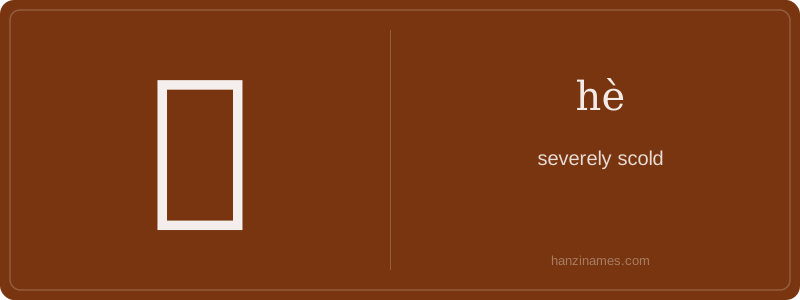
嗃 is virtually absent from spoken Mandarin and rarely appears in HSK vocabulary lists or modern textbooks. It occurs chiefly in classical poetry, Ming–Qing dynasty judicial records, and Confucian-influenced didactic texts—for instance, in phrases like '嗃然正色' (hè rán zhèng sè, 'scowling sternly with upright bearing'). No major idiom or fixed expression features it today; even dictionaries classify it as 'archaic' or 'literary.' Its usage peaked in late imperial administrative language when magistrates publicly rebuked offenders.
The character combines 口 (mouth radical) and 鶴 (hè, 'crane')—a phonetic component. Though cranes symbolize longevity and nobility, here 鶴 serves purely for pronunciation. This is a standard phono-semantic compound; no pictographic origin exists. In real life, Chinese speakers encounter 嗃 almost exclusively in annotated classical anthologies or academic contexts—not in conversation, signage, or media.
The character 嗃 (hè) is a rare, literary term meaning 'to scold harshly' or 'to rebuke with stern severity.' It conveys not just anger but authoritative, morally charged reprimand—often from elders, teachers, or officials. Unlike common verbs like 吼 (hǒu, 'to shout') or 骂 (mà, 'to curse'), 嗃 carries classical gravitas and appears almost exclusively in formal writing, historical texts, or stylized speech. Its rarity makes it a marker of linguistic sophistication rather than daily utility.
Phonetically, 嗃 belongs to the 'hè' sound group, sharing pronunciation with characters like 贺 (congratulate), 赫 (illustrious), and 褐 (brown)—but its meaning stands apart through semantic context and radical association. Though written with the mouth radical (口), it does not denote ordinary speech; instead, it evokes the visceral impact of a commanding, chastising voice that silences disobedience.
This character’s scarcity in modern usage reflects broader shifts in Chinese discourse: contemporary education and parenting increasingly emphasize positive reinforcement over authoritarian correction. Yet 嗃 persists in classical allusions, legal-historical documents, and literary criticism—where precision in depicting moral authority remains essential. Recognizing it signals familiarity with pre-modern rhetorical registers, not conversational fluency.
Example Sentences
Common Compounds
Similar Characters — Don't Mix These Up
Your First Step into Chinese Culture: Get a Chinese Name
Every journey into Chinese begins with a name. Use our free Chinese name generator to create a meaningful, personalized Chinese name that fits you perfectly.
Get My Chinese Name →