嗄
Character Story & Explanation
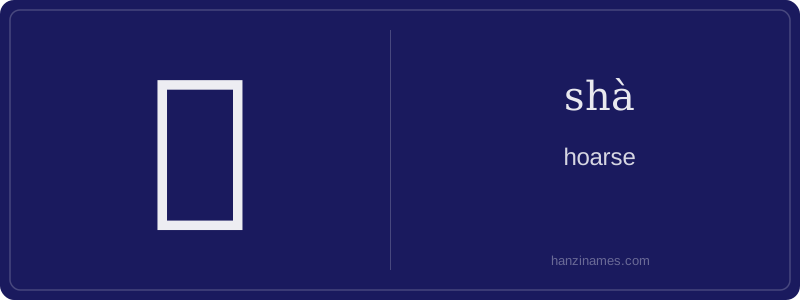
嗄 is used almost exclusively in literary, medical, or stylistic contexts to describe vocal hoarseness — especially in written Chinese. It appears in modern novels (e.g., Lu Xun’s works describing exhausted characters), traditional opera critiques, and clinical notes on laryngitis. You won’t hear it in casual speech; native speakers typically say 嗓子哑了 (sǎngzi yǎ le, 'voice went hoarse') instead. No major idioms feature 嗄 alone, but it occurs in fixed phrases like 嘎哑 (gāyǎ), a variant spelling sometimes seen in older print.
The character is not pictographic — its form evolved from seal script where 口 + 葛 represented sound imitation and phonetic borrowing. 葛 originally denoted a plant (kudzu), but was repurposed for its sound value. There’s no oracle-bone record of 嗄; it emerged later in clerical script as a specialized phonetic loan for vocal quality.
Hello students! Today we’ll explore the character 嗄 (shà), which means 'hoarse' — that rough, strained voice you get after shouting or singing too long. It’s a phonetic-semantic compound: the 口 (kǒu, 'mouth') radical tells us it’s related to speech or sound, while the right side (葛) hints at pronunciation (though modern shà diverges from the original gě sound). This character is quite vivid — it doesn’t just describe voice quality; it evokes physical effort and vocal fatigue.
Don’t confuse 嗄 with common homophones like 沙 (shā, 'sand') or 杀 (shā, 'to kill') — tone and context matter deeply here. While shà is the fourth tone (falling), its meaning is specific and sensory. You’ll mostly encounter it in descriptive writing or literature, not daily small talk — think of a tired teacher’s voice at the end of class, or an actor rehearsing for hours. It’s expressive, but not conversational slang.
Though not in the HSK syllabus (HSK Level: Not included), 嗄 appears in advanced reading materials, classical poetry annotations, and medical or linguistic texts discussing voice disorders. Its rarity makes it a great 'deep-dive' character: mastering it signals nuanced understanding of Chinese sound symbolism and descriptive precision. As you practice writing it, notice how the mouth radical anchors the meaning — every time you write 口, you’re grounding the word in the body’s instrument of speech.
Example Sentences
Common Compounds
Similar Characters — Don't Mix These Up
Your First Step into Chinese Culture: Get a Chinese Name
Every journey into Chinese begins with a name. Use our free Chinese name generator to create a meaningful, personalized Chinese name that fits you perfectly.
Get My Chinese Name →