呛
Character Story & Explanation
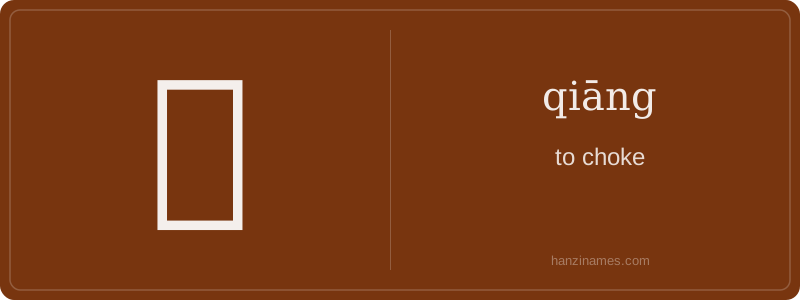
In daily life, 呛 most commonly describes involuntary physical reactions: choking on smoke, spice, or steam—e.g., ‘被辣椒呛到了’ (bèi làjiāo qiāng dào le, ‘choked on chili’). It appears in the widely used phrase 呛咳 (qiāngké, ‘paroxysmal cough’) in medical contexts and news reports about air pollution. The 2022 China National Standard GB/T 28039-2022 on respiratory health terminology includes 呛 as a key term for irritant-induced airway reflexes.
The character’s form has no verified pictographic origin—it’s a phono-semantic compound: 口 (mouth, semantic) + 倉 (cāng, phonetic). Since 倉 itself evolved from a granary pictograph, there’s no direct visual link to choking. Instead, think of a real moment: a chef in Sichuan suddenly coughing mid-wok-toss as chili oil fumes hit their throat—that’s 呛 in action.
Our detective begins at the scene: the character 呛 appears in early Chinese dictionaries like the Shuōwén Jiězì (121 CE), where it’s classified under the 口 (mouth) radical and defined as ‘to choke or gasp from irritation’—not from lack of air, but from sudden, harsh stimulation. Its phonetic component is 倉 (cāng), suggesting sound borrowing rather than semantic logic. Unlike pictographic characters, 呛 offers no visual clue to choking; instead, its structure signals vocal disruption—a mouth forced into reactive motion.
The dual pronunciation tells a tale of linguistic evolution: qiāng (first tone) is standard for the verb ‘to choke’, while qiàng (fourth tone) appears in regional speech and fixed expressions like 呛声 (qiàngshēng, ‘to interrupt sharply’). This tonal split reflects historical phonetic drift and register variation—not dialectal error, but documented usage preserved in modern Mandarin dictionaries like the Xiàndài Hànyǔ Cídiǎn.
Crucially, 呛 is not a classical literary character but a late-emerging vernacular one. It rarely appears in pre-Qing poetry or Confucian texts, surfacing instead in Ming-Qing vernacular novels and 20th-century spoken-language reform materials. Its rise parallels the codification of colloquial Mandarin—making 呛 a linguistic fingerprint of everyday speech gaining lexical legitimacy, not an ancient oracle-bone relic.
Example Sentences
Common Compounds
Similar Characters — Don't Mix These Up
Your First Step into Chinese Culture: Get a Chinese Name
Every journey into Chinese begins with a name. Use our free Chinese name generator to create a meaningful, personalized Chinese name that fits you perfectly.
Get My Chinese Name →