嗒
Character Story & Explanation
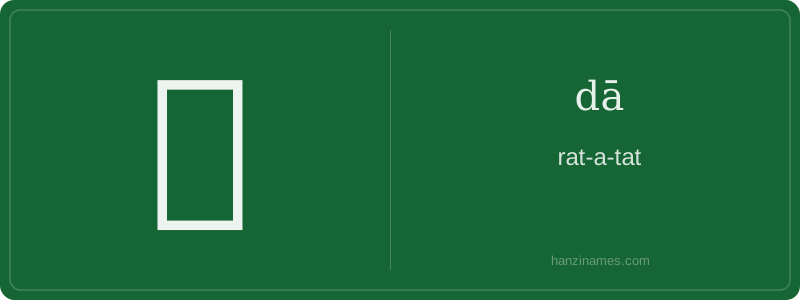
嗒 is widely used in modern Chinese literature, film subtitles, and online writing to convey crisp, repetitive mechanical or percussive sounds. You’ll see it in war novels (e.g., 嗒嗒的机枪声 — 'rat-a-tat of a machine gun'), suspense scenes (嗒…嗒…嗒 — echoing footsteps), or animated comics (manhua) for clock ticks or door knocks. It appears in standardized textbooks like 《汉语口语速成》 for teaching onomatopoeia, and is documented in the 《现代汉语词典》 (7th ed.) under onomatopoeic entries.
The character is a late creation — first attested in early 20th-century vernacular fiction. Its form combines 口 (sound source) and 答 (used phonetically for dā). Unlike ancient pictographs, 嗒 has no oracle-bone or bronze script origin; it was invented to fill a need for a written representation of this specific sharp, staccato sound in modern Mandarin.
Hi students! Today we’re learning 嗒 (dā), a fun and expressive Chinese character — but not one you’ll find in dictionaries as a standalone word. It’s an onomatopoeic character, meaning it imitates sounds — like the sharp, rhythmic 'da-da-da' of a machine gun, the steady 'tick-tock' of an old clock, or the quick clack of heels on tile. Because it mimics sound, it’s always used in reduplicated forms (like 嗒嗒) or within compound words, never alone.
Notice its radical: 口 (kǒu), meaning 'mouth'. That’s your clue — characters with 口 are almost always related to speech, sound, or oral action. The right side is 答 (dá), which means 'to answer', but here it’s borrowed purely for its sound (dā), not its meaning. This is called a 'phonetic loan' — a common strategy in Chinese writing where shape + sound combine to create new sound-words.
Don’t worry about memorizing 嗒 for HSK exams — it’s not included in any official HSK list (HSK Level: Not rated). That’s because it’s a functional sound-word, not a core vocabulary item. But understanding it helps you read novels, watch dramas, or interpret sound effects in comics and subtitles. Think of it like English ‘tick’, ‘clack’, or ‘rat-a-tat’ — context tells you the exact meaning, not the character itself.
Example Sentences
Common Compounds
Similar Characters — Don't Mix These Up
Your First Step into Chinese Culture: Get a Chinese Name
Every journey into Chinese begins with a name. Use our free Chinese name generator to create a meaningful, personalized Chinese name that fits you perfectly.
Get My Chinese Name →