嗔
Character Story & Explanation
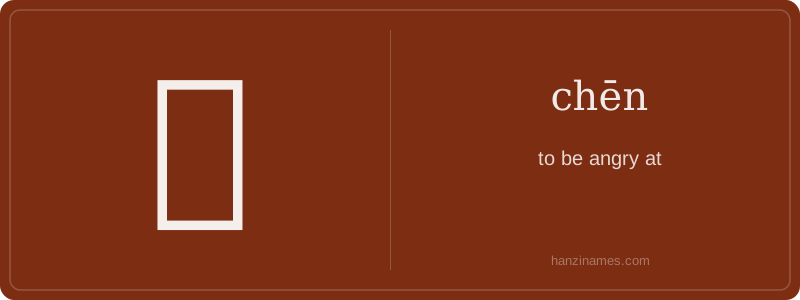
嗔 is widely used in classical literature, Buddhist sutras, and modern literary Chinese to denote mild-to-moderate anger—especially in interpersonal, familial, or moral contexts. It appears in idioms like 嗤之以鼻 (chī zhī yǐ bí, 'to snort at something with contempt') and the compound 嗤怒 (chēn nù, 'irritated anger'). Historically, it was common in Ming-Qing novels (e.g., *Dream of the Red Chamber*) to describe refined characters’ restrained disapproval—never shouting, always a ‘tightened lip’ or ‘glance askance’. Today, it’s rare in casual speech but frequent in writing, media commentary, and moral discourse.
The character evolved from seal script, where 口 (mouth) + 眞 (zhēn, ‘true’, later simplified to 真) formed 嗔—originally suggesting ‘truthful expression of dissatisfaction’. Though the ‘woman’ (女) component appears visually in the lower part of modern 嗔, this is actually a graphical simplification of 眞, not a semantic reference to gender. Its origin is phonosemantic: 口 signals speech-related meaning; 眞 provides sound (chēn shares phonetic lineage with 眞/zhēn).
嗔 (chēn) is more than simple anger—it reflects a culturally nuanced, morally weighted form of displeasure. In Confucian and Buddhist thought, 嗔 signifies reactive, ego-driven irritation—often seen as an obstacle to wisdom and harmony. Unlike righteous indignation (義憤), 嗤 carries connotations of pettiness or attachment; it’s the frown of a parent correcting a child, not the roar of protest against injustice. This distinction reveals a core Chinese worldview: emotions are not neutral but ethically calibrated.
Rooted in the 口 (mouth) radical, 嗔 emphasizes the vocalized, expressive dimension of anger—scolding, sighing, sharp-toned rebukes—not silent seething. Its thirteen strokes include the ‘woman’ component (女) beneath 口, historically hinting at gendered stereotypes of emotional expressiveness, though modern usage is fully gender-neutral. The character thus encodes how emotion manifests socially: through voice, restraint, and relational context.
Crucially, 嗔 appears frequently in Buddhist texts (e.g., the Three Poisons: 貪瞋癡—greed, hatred, delusion), where it’s treated as a mental affliction requiring cultivation to transcend. This frames anger not as catharsis but as a disturbance needing mindfulness. Such framing invites reflection: in Chinese culture, managing 嗔 isn’t about suppression, but about recognizing its roots in expectation, pride, or loss of equanimity—a quiet philosophical discipline embedded in a single character.
Example Sentences
Common Compounds
Similar Characters — Don't Mix These Up
Your First Step into Chinese Culture: Get a Chinese Name
Every journey into Chinese begins with a name. Use our free Chinese name generator to create a meaningful, personalized Chinese name that fits you perfectly.
Get My Chinese Name →