跳
Character Story & Explanation
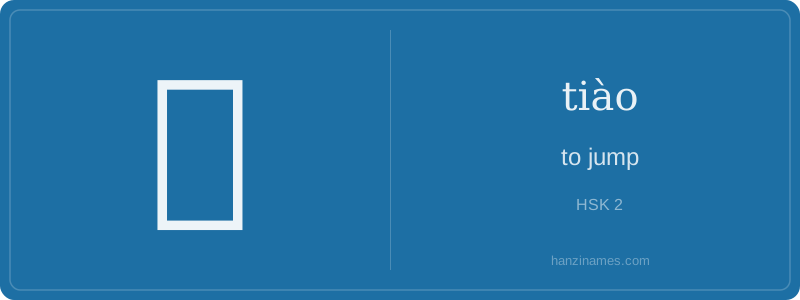
跳 is widely used in daily life—from children’s games (跳绳 tiàoshéng, skipping rope) to workplace slang (跳槽 tiàocǎo, job-hopping). It appears in classical texts like the *Book of Songs* (Shījīng), where 跳躍 (tiàoyuè, ‘leaping’) describes joyful movement. The idiom 龙腾虎跃 (lóng téng hǔ yuè, ‘dragons soar, tigers leap’) evokes vigorous prosperity and remains common in New Year celebrations and business rhetoric.
The character’s form dates to seal script (c. 3rd century BCE), evolving from a pictophonetic compound: 足 (radical, meaning ‘foot’) + 兆 (shēngpáng, phonetic component, indicating pronunciation). While 兆 originally meant ‘omen’ or ‘crack in tortoise shell’, its sound value (zhào → tiào via historical sound shift) was repurposed here—no mythic origin, just linguistic adaptation. Today, Chinese students practice its 13-stroke order daily, and fitness apps use 跳 in workout labels like ‘跳操’ (aerobic jumping).
The character 跳 (tiào) embodies more than physical motion—it reflects a cultural reverence for dynamic energy, spontaneity, and upward momentum. In Chinese philosophy, movement isn’t merely locomotion but a manifestation of qi (vital energy) in action. Jumping—whether in martial arts, folk dance, or childhood play—symbolizes vitality, readiness, and the breaking of inertia. This aligns with Daoist ideals of natural flow and Confucian emphasis on embodied virtue: one ‘jumps’ not just with legs, but with intention and spirit.
Unlike English’s static verb ‘jump’, 跳 carries layered grammatical flexibility: it functions as both transitive and intransitive, appears in resultative complements (e.g., 跳过去), and extends metaphorically to abrupt transitions—‘jumping’ to conclusions, stock markets, or careers. This semantic elasticity mirrors how Chinese language often encodes process and relational change rather than fixed states, revealing a worldview where identity is enacted through movement and context.
Even its radical 足 (foot) signals embodiment: knowledge and agency begin *from the ground up*. You don’t think your way into action—you step, then leap. In traditional opera, acrobatic jumps (like the famous 翻腾 jump-rolls) convey heroism without words; in modern life, phrases like 跳槽 (‘jump槽’—change jobs) normalize reinvention as natural, even virtuous. Thus, 跳 subtly affirms that growth requires leaving the familiar behind—not recklessly, but with grounded intent.
Example Sentences
Common Compounds
Similar Characters — Don't Mix These Up
Your First Step into Chinese Culture: Get a Chinese Name
Every journey into Chinese begins with a name. Use our free Chinese name generator to create a meaningful, personalized Chinese name that fits you perfectly.
Get My Chinese Name →