踢
Character Story & Explanation
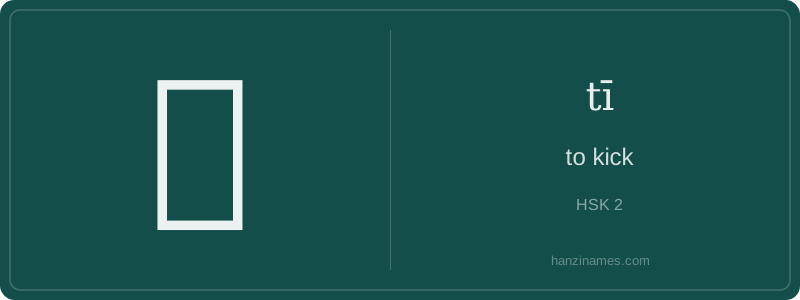
踢 is widely used in modern Chinese daily life—from sports commentary (‘他一脚踢进对方球门!’) to parenting warnings (‘别踢桌子!’), and digital slang (‘踢人’ meaning ‘to remove someone from a WeChat group’). It appears in the HSK 2 curriculum and is essential for describing physical activity, sports, and digital interactions. The idiom ‘踢皮球’ (tī píqiú, ‘to kick the leather ball’) historically described bureaucratic buck-passing—a vivid metaphor still used in official media reports by Xinhua and People’s Daily.
The character’s form dates to the Qin–Han clerical script era. It is a phono-semantic compound: 足 (radical, indicating foot-related action) + 易 (phonetic, approximating tī). No oracle-bone or bronze inscriptions of 踢 exist—it emerged later as foot-based verbs diversified. Today, Chinese children learn it early via soccer drills, playground rules, and classroom role-plays about respectful movement.
The character 踢 (tī) embodies the Chinese worldview that meaning arises from embodied action—not just abstract thought, but physical engagement with the world. Its radical 足 (foot) anchors it in human movement, while the phonetic component 易 (yì, 'easy/change') subtly suggests that kicking is both a natural, instinctive motion and a transformative act—shifting momentum, asserting boundaries, or redirecting energy. This reflects a Confucian- and Daoist-influenced perspective: the body is not separate from mind or morality; how one moves matters.
In traditional Chinese martial arts and folk games like cuju (an ancient ball game predating soccer), kicking was never merely athletic—it carried ritual, discipline, and social symbolism. A well-timed kick could demonstrate self-control (not aggression), precision over force, and harmony between intention and motion. Thus, 踢 encapsulates a cultural ideal: power exercised with awareness, not brute strength. Even today, teachers correct students’ ‘kicking posture’ not just for form, but as embodied ethics.
Modern usage extends this embodied philosophy into metaphor: ‘kicking away’ bad habits (踢开陋习), ‘kicking off’ events (踢球开场), or ‘kicking out’ unqualified members (踢出团队). These phrases retain the character’s core sense of decisive, directional action—yet always imply agency, consequence, and intentionality. Unlike English ‘kick’, which can be reflexive or accidental, 踢 in Chinese discourse almost always connotes conscious, purposeful motion—revealing a worldview where bodily acts are morally and socially legible.
Example Sentences
Common Compounds
Similar Characters — Don't Mix These Up
Your First Step into Chinese Culture: Get a Chinese Name
Every journey into Chinese begins with a name. Use our free Chinese name generator to create a meaningful, personalized Chinese name that fits you perfectly.
Get My Chinese Name →