身
Character Story & Explanation
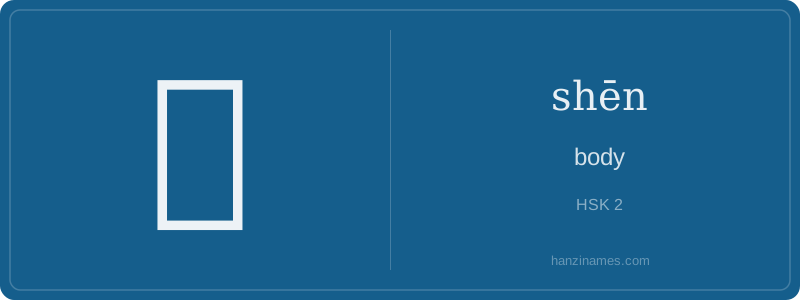
In modern Mandarin, 身 appears ubiquitously: in health contexts (身体 shēntǐ, 'body'), identity expressions (本身 běnshēn, 'in itself/itself'), and moral phrases like 以身作则 (yǐ shēn zuò zé, 'set an example by one’s own conduct')—a phrase rooted in Mencius and still taught in schools. It’s central to HSK 2 vocabulary and appears in over 20 official HSK compound words. Government forms use 身份证 (shēnfènzhèng, 'ID card')—literally 'body-identity document'—reflecting its enduring link between physical existence and civic status.
The character is a documented pictograph: oracle bone and bronze script versions (c. 1200 BCE) clearly depict a kneeling or standing human figure with emphasized torso and limbs—no head or facial features, focusing attention on the trunk as the core of personhood. This visual emphasis on the body’s center (not the face or brain) signals its ancient conceptual role as the seat of vitality and action.
As an archaeologist brushing dust from a Warring States bamboo slip, I find 身 etched not as a static glyph—but as a living fossil of embodied experience. Its earliest forms in bronze inscriptions (c. 1000 BCE) already show a stylized human torso with arms and legs subtly implied—not as anatomical diagram, but as a marker of presence, agency, and social role: the ‘self’ as situated, accountable, physical being.
This character never meant just flesh and bone. In Confucian texts like the Analects, 身 is the locus of moral cultivation—‘cultivating one’s body’ (修身) meant aligning conduct, speech, and thought. Legalist documents used it to denote personal liability: punishment fell upon the body itself, making identity inseparable from consequence. Thus, 身 encoded early Chinese ontology: personhood was enacted *through* the body, not housed *in* it.
By the Han dynasty, 身 expanded semantically into pronouns (‘oneself’) and classifiers (e.g., 一身衣裳—‘a full set of clothes’), revealing how deeply embodiment structured language. Unlike Western dualisms, 身 resisted mind–body splits—it carried weight, history, responsibility, and relationality. To write 身 was to invoke a whole cosmology where ethics, law, medicine, and ritual converged on the lived human form.
Example Sentences
Common Compounds
Similar Characters — Don't Mix These Up
Your First Step into Chinese Culture: Get a Chinese Name
Every journey into Chinese begins with a name. Use our free Chinese name generator to create a meaningful, personalized Chinese name that fits you perfectly.
Get My Chinese Name →