近
Character Story & Explanation
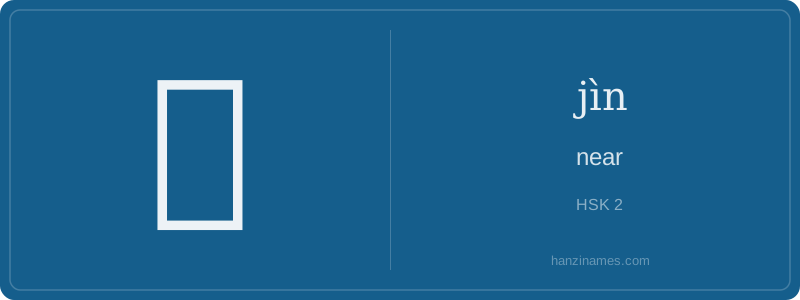
近 is widely used in modern Mandarin for physical proximity (e.g., ‘近处’ jìnchù, 'nearby place'), time ('近期' jìnqī, 'recent period'), and relationships ('亲近' qīnjìn, 'to be close to someone'). It appears in the classical idiom '远亲不如近邻' (yuǎn qīn bùrú jìn lín, 'distant relatives are not as helpful as near neighbors') — a Confucian-influenced saying still quoted in community contexts today.
The character’s earliest attested form is in Qin dynasty bamboo slips (3rd c. BCE), where it combines 尽 (a phonetic component suggesting 'exhaustion' or 'completion') with 辶 (movement radical). It does *not* originate as a pictograph of a person walking — that’s a common misconception. Instead, it’s a phono-semantic compound: sound from 尽, meaning from 辶 — conveying 'approaching completion', hence 'nearness'.
Hi students! Let’s explore 近 (jìn), meaning 'near' or 'close' — a foundational HSK Level 2 character. It’s made of just 7 strokes and belongs to the 辶 (chuò) radical, which always relates to movement or walking — think of it as 'approaching' something. This character appears frequently in daily speech and writing, from giving directions ('the station is near') to describing relationships ('close friend'). Understanding 近 helps you grasp spatial, temporal, and even emotional proximity in Chinese.
Notice how 近 looks like a person (the top part 尽, simplified here as ⺍+冂+丨) moving toward something — reinforced by the walking radical 辶 on the right. Though the modern form is standardized, its ancient seal script already conveyed 'coming close'. You’ll often see it paired with words like 距离 (jùlí, distance), 时间 (shíjiān, time), or 朋友 (péngyou, friend) to express closeness in different dimensions.
Don’t confuse 近 with similar-sounding characters like 进 (jìn, 'to enter') — they share pronunciation but differ in meaning and radicals. Practice writing 近 stroke-by-stroke: start with the upper component (⺍), then the frame (冂), vertical line (丨), and finally the walking radical 辶 — remember: 辶 is written last, and its three strokes (dot, horizontal fold,捺 nà) must flow smoothly. Mastering this character opens doors to dozens of useful compounds!
Example Sentences
Common Compounds
Similar Characters — Don't Mix These Up
Your First Step into Chinese Culture: Get a Chinese Name
Every journey into Chinese begins with a name. Use our free Chinese name generator to create a meaningful, personalized Chinese name that fits you perfectly.
Get My Chinese Name →