送
Character Story & Explanation
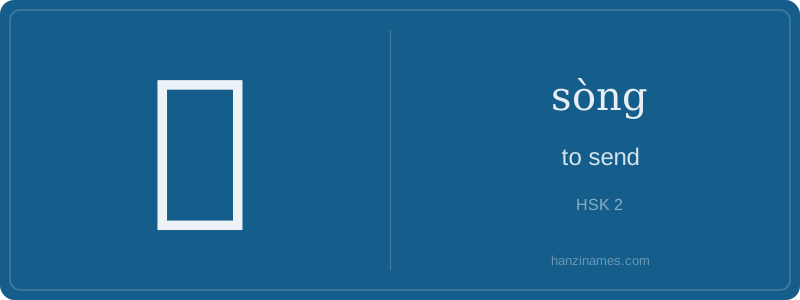
In daily life, 送 is indispensable: parents 送孩子上学 (sòng háizi shàngxué, 'send children to school'), couriers 送外卖 (sòng wàimài, 'deliver takeout'), and colleagues 送祝福 (sòng zhùfú, 'send blessings') during festivals. It appears in the HSK 2–3 curriculum as a core verb for transactional and relational actions. Historically, the *Tang Code* mandated officials to 送囚至京 (sòng qiú zhì jīng, 'escort prisoners to the capital'), underscoring its legal gravity. The idiom 送佛送到西天 (sòng fó sòng dào xītiān, 'send the Buddha all the way to the Western Heaven') reflects its cultural emphasis on completion and sincerity.
The character’s form is well-documented: 送 is a phono-semantic compound. The radical 辶 (chuò, ‘walking’) signals motion-related meaning; the phonetic component 曾 (zēng, now pronounced sòng due to sound shift) originally provided pronunciation. Oracle bone or bronze inscriptions do not contain 送—it first appears reliably in Warring States bamboo texts and matured in Qin small seal script, confirming its origin as a late Zhou administrative innovation for formal dispatch.
As an archaeologist brushing dust from a Han dynasty bamboo slip, I uncovered 送 not as a static glyph—but as a ritualized motion: the deliberate act of dispatching something vital across space and time. Its radical 辶 (‘walking’) anchors it in physical movement, while the upper component 丿+龺 (a simplified form of 關, later standardized as 送’s phonetic) hints at controlled passage—like handing over a sealed document at a frontier post. This wasn’t mere delivery; it was sanctioned transit, bearing weight of trust and obligation.
The character’s nine-stroke structure reveals careful choreography: first the walking radical’s three strokes (dotted line, horizontal fold, sweeping捺), then six precise strokes above—each marking a phase of release and direction. Excavated clerical script fragments from Dunhuang show 送 evolving from a more complex seal-script form emphasizing gateways and escorts, reflecting its early use in official courier systems documented in the *Book of Han*. It encoded accountability: sender, recipient, and route were all implied.
Unlike modern digital ‘sending’, ancient 送 demanded presence—the sender often accompanied the item partway, a gesture captured in the character’s very composition: the ‘walking’ radical isn’t passive—it’s active propulsion. Even today, when Chinese people say ‘I’ll send it’, the cultural residue remains: sending implies care, timing, and responsibility. That’s why 送 appears in mourning rites (送葬, ‘to escort the deceased’) and diplomatic missions (送使, ‘to dispatch an envoy’) alike—not just transfer, but transition with dignity.
Example Sentences
Common Compounds
Similar Characters — Don't Mix These Up
Your First Step into Chinese Culture: Get a Chinese Name
Every journey into Chinese begins with a name. Use our free Chinese name generator to create a meaningful, personalized Chinese name that fits you perfectly.
Get My Chinese Name →