嗷
Character Story & Explanation
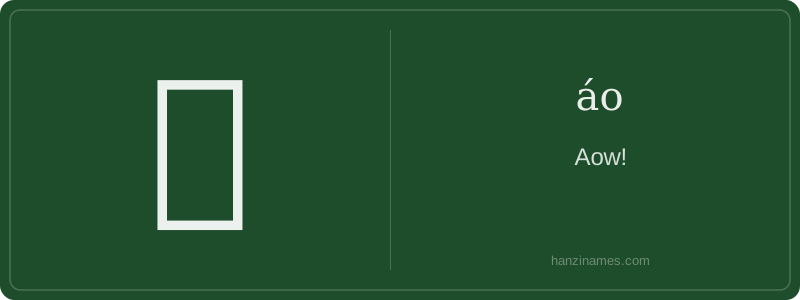
嗷 is rarely used in formal writing or classical texts but thrives in modern spoken and digital Chinese: it appears frequently in novels, web fiction, memes, and subtitles to dramatize exaggerated vocal reactions — think characters screaming in panic, fans cheering wildly, or cartoonish despair. It’s documented in contemporary corpora like the Sinica Corpus and BCC Corpus, consistently tagged as an interjection (INTJ) with high frequency in informal registers. While no classical idiom centers on 嗷, it appears in compound expressions like 嗷嗷叫 (áo’áo jiào), used since at least the 1950s in agricultural reports to describe livestock vocalizing — later adopted colloquially for human enthusiasm or complaint.
The character is not attested in oracle bone or bronze inscriptions. Its earliest reliable appearance is in late imperial vernacular texts and Qing dynasty folk songs. Today, Chinese learners encounter it most often in online contexts — e.g., a Weibo post captioned ‘看到偶像出场我直接嗷——!!!’ — capturing real-time, emotionally amplified vocal reaction. Its form is purely phono-semantic: 口 + 敖, with no pictorial origin.
Our detective begins at the crime scene: the character 嗷. Its radical 口 (mouth) immediately signals vocalization — a classic phonosemantic compound where meaning and sound converge. The right component, 敖 (áo), serves dual duty: it phonetically hints at pronunciation while historically evoking 'roaming' or 'boasting', suggesting unrestrained, projecting sound. This isn’t a pictograph of noise — it’s a crafted linguistic artifact designed to encode both how the sound is made (through the mouth) and its quality (loud, uncontained, emphatic).
Zooming in on stroke order (13 strokes), every line tells a story: the left 口 is written first — grounding the action in speech; then 敖 unfolds with deliberate flourishes — horizontal sweeps mimic open-mouthed projection, and the final dot (丶) acts like an acoustic exclamation point. Unlike ancient oracle-bone inscriptions (where 嗷 has no attested form), this character emerged later, likely during the Han or Tang dynasties, as vernacular expression demanded richer onomatopoeic tools for depicting collective outcry.
Modern linguistic forensics confirm 嗷 functions almost exclusively as an interjection or mimetic verb — never as a standalone noun or adjective. It resists dictionary definition like a suspect refusing to be pinned down: dictionaries list it as 'onomatopoeic for loud, drawn-out cries', often with emotive qualifiers like 'wailing', 'howling', or 'roaring'. Crucially, it carries strong affective weight — not neutral sound, but sound charged with pain, excitement, or absurdity — making it a favorite in expressive writing, internet slang, and animated dialogue.
Example Sentences
Common Compounds
Similar Characters — Don't Mix These Up
Your First Step into Chinese Culture: Get a Chinese Name
Every journey into Chinese begins with a name. Use our free Chinese name generator to create a meaningful, personalized Chinese name that fits you perfectly.
Get My Chinese Name →