嘂
Character Story & Explanation
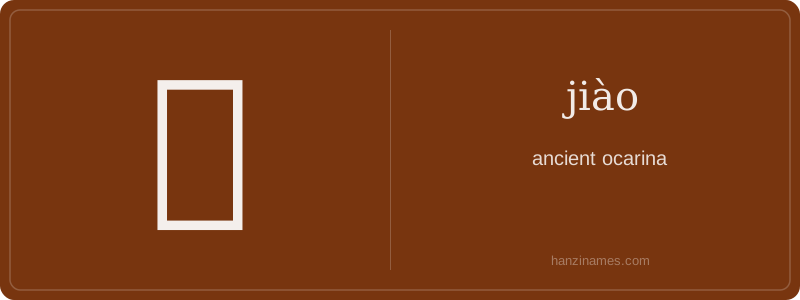
嘂 is virtually unused in modern Chinese daily life. It appears exclusively in classical dictionaries, academic papers on pre-Qin music, and museum catalog entries—for example, in descriptions of Neolithic pottery wind instruments unearthed at Banpo (c. 5000 BCE) or Erlitou sites. No idioms, phrases, or compound words containing 嘂 exist in standard usage; it has no presence in HSK, textbooks, media, or digital input methods.
The character’s form is not pictographic but phono-semantic: the left component 口 ('mouth') signals its relation to sound or blowing, while the right 叫 (jiào, 'to cry/shout') serves as both phonetic and semantic reinforcement—suggesting vocalized or breath-driven sound production. Though 叫 itself evolved from oracle-bone forms depicting a person calling, 嘂 was deliberately constructed later as a specialized variant for instrumental tone, not human voice.
The character 嘂 (jiào) is a rare, archaic Chinese character documented in ancient dictionaries like the Shuōwén Jiězì (c. 100 CE), where it is defined as a type of earthenware wind instrument—similar to an ocarina—with multiple finger holes and a soft, resonant tone. It belonged to the category of ‘blown instruments’ (吹器) used in early Zhou dynasty rituals and court music, not for entertainment but for ceremonial harmony and cosmic alignment.
Unlike common characters such as 乐 (lè, 'music') or 笛 (dí, 'flute'), 嘂 never entered daily vocabulary or modern Standard Mandarin usage. It appears only in philological texts, archaeological reports on excavated musical artifacts, and specialized studies of ancient Chinese musicology. Its pronunciation jiào is preserved solely through dictionary citations—not spoken in contemporary speech or song.
This character exemplifies how Chinese writing preserves cultural memory beyond living language. Even though no one plays a 'jiào' today—or uses the word orally—the glyph endures as a lexical fossil, anchoring scholarly understanding of China’s Bronze Age acoustic culture. Its survival reminds us that writing can be archaeology: silent, precise, and deeply historical.
Example Sentences
Common Compounds
Similar Characters — Don't Mix These Up
Your First Step into Chinese Culture: Get a Chinese Name
Every journey into Chinese begins with a name. Use our free Chinese name generator to create a meaningful, personalized Chinese name that fits you perfectly.
Get My Chinese Name →