嘅
Character Story & Explanation
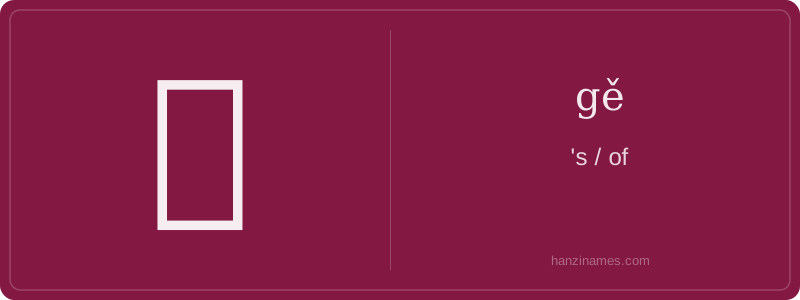
嘅 is ubiquitous in modern Cantonese writing — especially in Hong Kong media since the 1970s, when vernacular writing gained legitimacy in newspapers and film subtitles. It appears in official signage (e.g., MTR station announcements), pop lyrics (e.g., songs by Sammi Cheng), and government multilingual documents alongside English and traditional Chinese. Unlike classical particles, 嘅 has no pre-modern literary usage; it emerged organically in 20th-century colloquial orthography to represent the spoken possessive marker /kɛː/.
The character is a phonetic loan: its form combines 口 (indicating speech) and 既 (jǐ, an archaic character meaning 'already', repurposed here for sound). It bears no semantic relation to 'possession' — unlike Mandarin 的, which evolved from a verb meaning 'to obtain'. There’s no oracle bone or seal script form; 嘅 was created in the late Qing–early Republican era as a practical orthographic solution for Cantonese speakers.
Hi students! Let’s talk about 嘅 — a character you’ll hear *every day* in spoken Cantonese, but one that’s *not used in standard Mandarin*. It’s pronounced 'gě' and functions as a possessive particle, like English 's or 'of'. Think of it as the Cantonese equivalent of Mandarin’s 的 (de). Even though it looks like a formal written character, it’s almost exclusively used in informal writing — like text messages, social media, subtitles, or song lyrics — to reflect how people actually speak in Hong Kong and Guangdong.
Don’t confuse 嘅 with Mandarin grammar! It appears only in Cantonese contexts and is rarely taught in mainland textbooks. Its radical 口 (mouth) signals its spoken nature — it’s a *phonetic loan character*, chosen for sound, not meaning. The 12 strokes include a ‘mouth’ on the left and a complex right side (ge + kou), but you won’t write it in HSK exams — because it’s *not in the HSK syllabus at all*. Yes — zero HSK level. It’s purely colloquial Cantonese.
As your Chinese teacher, I want you to understand: this character bridges speech and script in southern China. If you watch Hong Kong dramas, read Cantopop lyrics, or chat with friends from Guangzhou, you’ll see 嘅 constantly — always after a noun or pronoun to show possession or description. It’s grammatical glue, not vocabulary. Mastering it helps you *decode real-life Cantonese*, even if you’re learning Mandarin first. Just remember: no Mandarin textbook uses it — and that’s intentional!
Example Sentences
Common Compounds
Similar Characters — Don't Mix These Up
Your First Step into Chinese Culture: Get a Chinese Name
Every journey into Chinese begins with a name. Use our free Chinese name generator to create a meaningful, personalized Chinese name that fits you perfectly.
Get My Chinese Name →