喽
Character Story & Explanation
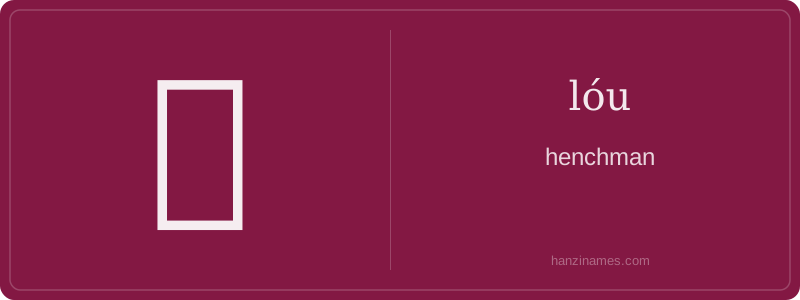
喽 is almost exclusively used in the compound 喽啰 (lóu luó), meaning 'henchmen' or 'underlings', especially in historical or literary contexts. It appears in official Qing dynasty legal records describing bandit suppression campaigns and is central to the phrase '山大王和喽啰' ('mountain king and his henchmen')—a stock trope in traditional storytelling. Modern usage is largely idiomatic or humorous: e.g., jokingly calling office coworkers '老板的喽啰' ('boss’s henchmen') to tease hierarchical workplace dynamics.
The character is not pictographic; its form combines 口 (mouth, suggesting oral/slang usage) and 楼 (lóu, 'building') as a phonetic component—though 楼 itself is not semantically relevant. Its origin lies in Tang-Song vernacular phonetic borrowing (a 'phonosemantic compound'), not ancient glyphs. Today, native speakers encounter it almost solely in 喽啰—and rarely write it alone.
The character 喽 (lóu) is a colloquial, slightly archaic term denoting low-ranking henchmen or underlings in criminal or outlaw groups—especially in classical and vernacular Chinese literature. It carries connotations of blind obedience, marginal status, and often comic or contemptuous undertones. Unlike neutral terms like 'assistant' or 'follower', 喽 implies subservience within an illegitimate hierarchy, evoking images of bandit gangs in mountain strongholds or corrupt local militias.
In modern usage, 喽 rarely appears in formal contexts but surfaces frequently in historical novels, operas, film subtitles, and satirical speech—often to mock someone’s uncritical loyalty or lack of independent judgment. Its tone is mildly derogatory but rarely harsh; it’s more teasing than insulting, akin to calling someone a 'yes-man' or 'henchperson' with a wink.
Western equivalents include 'goon', 'thug', 'lackey', or 'henchman'—but none map perfectly. 'Goon' emphasizes brutishness, 'lackey' stresses servility, while 喽 uniquely blends linguistic informality (the 口 radical hints at spoken, slangy origin) with literary resonance from Ming-Qing fiction like Water Margin. It’s less about violence and more about hierarchical role-playing within outlawed social structures.
Example Sentences
Common Compounds
Similar Characters — Don't Mix These Up
Your First Step into Chinese Culture: Get a Chinese Name
Every journey into Chinese begins with a name. Use our free Chinese name generator to create a meaningful, personalized Chinese name that fits you perfectly.
Get My Chinese Name →