嘎
Character Story & Explanation
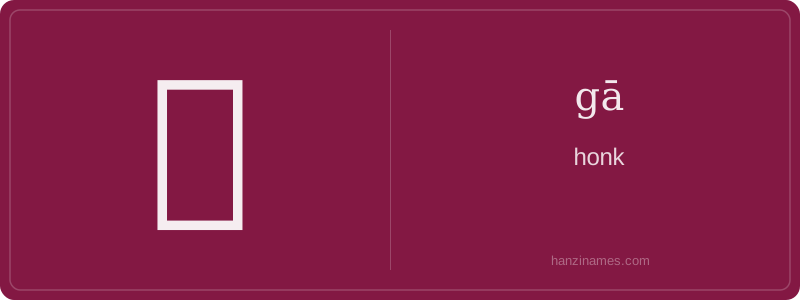
嘎 is overwhelmingly used as an onomatopoeic interjection in modern Standard Mandarin and regional dialects—especially in Northeast China. It appears in written dialogue to mimic sharp, abrupt sounds: goose honks (‘嘎——’), breaking twigs, or a sudden halt. It’s documented in the 1958 *Dictionary of Commonly Used Dialect Words* (《方言词典》) as a key feature of Dongbei speech, later popularized in CCTV Spring Festival Galas via comedians like Zhao Benshan. No historical oracle-bone or bronze script form exists; it first appears in Ming-Qing vernacular novels as a phonetic loan character.
The character’s structure is straightforward: 口 (radical, indicating speech/sound) + 戈 (phonetic component, historically approximating /ka/). While 戈 originally meant ‘halberd’, here it serves only as a sound cue—not meaning ‘weapon’. This is a classic example of a phono-semantic compound with zero semantic contribution from the right side.
As an archaeologist sifting through layers of linguistic sediment, I find 嘎 not in oracle bones—but in the resonant echoes of spoken Chinese. Its radical 口 (mouth) anchors it firmly in vocalization, while the right component, 戈 (a halberd), once thought to be phonetic, now reads more like a fossilized sound marker—suggesting early Middle Chinese *kɑ, a guttural, abrupt release. This isn’t a pictograph of an object, but a phonosemantic relic: mouth + sharp articulation.
Unlike characters born from concrete imagery (e.g., 日 for 'sun'), 嘎 emerged from onomatopoeic necessity—capturing the sudden, grating cry of geese, the metallic 'clack' of a door latch, or the choked gasp of surprise. Its three tones (gā/gá/gǎ) aren’t arbitrary: they map real-world acoustic variations—level tone for steady honking, rising for startled interjection, falling-rising for ironic or mocking repetition.
Modern excavations reveal that 嘎 never entered classical literary texts as a standalone word. Instead, it thrived in vernacular speech, opera stage directions, and 20th-century dialect literature—especially Northeastern (Dongbei) Mandarin, where it became a lexical signature of rustic authenticity and comedic timing. Its survival is less about antiquity and more about sonic utility: a compact, visceral syllable that resists abstraction.
Example Sentences
Common Compounds
Similar Characters — Don't Mix These Up
Your First Step into Chinese Culture: Get a Chinese Name
Every journey into Chinese begins with a name. Use our free Chinese name generator to create a meaningful, personalized Chinese name that fits you perfectly.
Get My Chinese Name →