啧
Character Story & Explanation
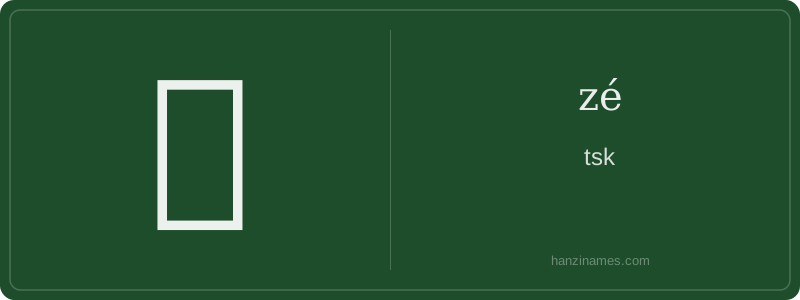
啧 appears frequently in modern Chinese fiction, film subtitles, and informal writing to transcribe the tongue-click sound—especially in dialogue expressing skepticism, affectionate scolding, or wry amusement. It’s documented in dictionaries since at least the 1930s (e.g., Xiāndài Hànyǔ Cídiǎn) and commonly paired with verbs like 啧啧 (zézé) to mimic repetitive clicking. While no classical idiom features 啧 alone, it’s integral to expressive onomatopoeic reduplications used across dialects and media.
The character is a phono-semantic compound: 口 (kǒu, 'mouth') as semantic radical signals oral origin; 责 (zé, 'to blame') as phonetic component provides sound—but not meaning. Its form stabilized during the clerical script era (2nd c. BCE); no oracle-bone or bronze inscription evidence exists. Today, you’ll hear it when a grandmother clicks her tongue while handing extra dumplings—'啧,又吃这么多!'—a warm, wordless commentary on love disguised as mild reproach.
啧 (zé) is far more than a phonetic gesture—it’s a linguistic microcosm of Chinese relational ethics. In Confucian-influenced communication, direct criticism is often softened through paralinguistic cues; 啧 serves precisely this function: a nonverbal sigh-click that conveys mild disapproval, gentle teasing, or empathetic exasperation—without naming fault. It preserves face (miànzi) for both speaker and listener, embodying the cultural preference for implicit, context-rich expression over blunt assertion.
This character reflects how Chinese language encodes social harmony as grammar. Unlike English ‘tsk’, which leans toward reprimand, 啧 in Mandarin carries layered tonal nuance: rising tone (zé) often signals playful disbelief ('Really?'), while flat tone (zē) may express weary resignation. Its oral radical 口 underscores embodiment—the sound emerges not from intellect alone, but from lived, bodily presence in shared space.
Culturally, 啧 reveals the aesthetic of restraint. In classical poetry and opera, such interjections were rarely written, yet their implied presence shaped pacing and emotional subtext. Today, its written use in literature, subtitles, and online dialogue marks moments where words fall short—and meaning resides in the pause between them. To utter 啧 is to acknowledge complexity without resolution: a quiet nod to life’s untranslatable textures.
Example Sentences
Common Compounds
Similar Characters — Don't Mix These Up
Your First Step into Chinese Culture: Get a Chinese Name
Every journey into Chinese begins with a name. Use our free Chinese name generator to create a meaningful, personalized Chinese name that fits you perfectly.
Get My Chinese Name →