嘞
Character Story & Explanation
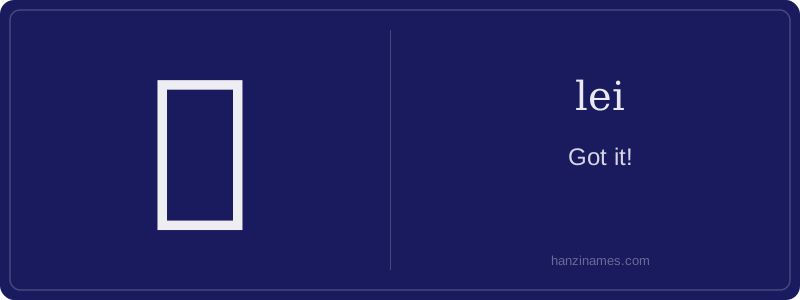
嘞 is a colloquial sentence-final particle used primarily in Northern and Northeastern Mandarin dialects, especially in Beijing and Heilongjiang speech. Documented since at least the early 20th century in vernacular fiction (e.g., Lao She’s dialogues), it expresses mild affirmation or satisfied acknowledgment—like saying 'Alright, got it!' or 'Sure thing!' with warmth. It rarely appears in formal writing or textbooks, but is ubiquitous in spoken interactions and digital communication.
The character has no ancient pictographic origin—it is a phono-semantic compound created during the Ming–Qing transition: 口 (radical, indicating speech) + 雷 (sound component, pronounced léi). Its form stabilized in printed vernacular literature, not oracle bones or bronze scripts. Today, Chinese speakers use it instinctively in casual replies: '行嘞!' ('Done!'), '好嘞!' ('Got it!')—always with upbeat, cooperative energy.
As an archaeologist sifting through layers of linguistic sediment, I uncover 嘞 not in oracle bones or bronze inscriptions—but in the living strata of modern Mandarin speech. Unlike ancient logographs carved for ritual permanence, 嘞 emerged organically in late imperial and Republican-era vernacular texts as a phonetic variant of 了, shaped by regional intonation and pragmatic need. Its radical 口 (mouth) signals its oral, performative essence: it is spoken, not inscribed; heard, not studied.
This character bears no excavated seal script form—it entered dictionaries only in the 20th century, first appearing in authoritative sources like the Xiandai Hanyu Cidian (1978). Its 14 strokes are not symbolic glyphs but functional scaffolding: 口 anchors it to speech, while 雷 (léi, 'thunder') provides sound—and subtly echoes the emphatic, resonant quality of approval it conveys. There is no mythic origin, only sociolinguistic evolution.
What makes 嘞 archaeologically fascinating is its resistance to standardization: it remains absent from the HSK syllabus (HSK Level: Not rated), yet thrives in informal writing—WeChat messages, subtitles, online forums—where tone matters more than orthography. It’s a linguistic fossil still breathing, proof that language isn’t buried—it’s continually re-deposited in everyday utterance.
Example Sentences
Common Compounds
Similar Characters — Don't Mix These Up
Your First Step into Chinese Culture: Get a Chinese Name
Every journey into Chinese begins with a name. Use our free Chinese name generator to create a meaningful, personalized Chinese name that fits you perfectly.
Get My Chinese Name →